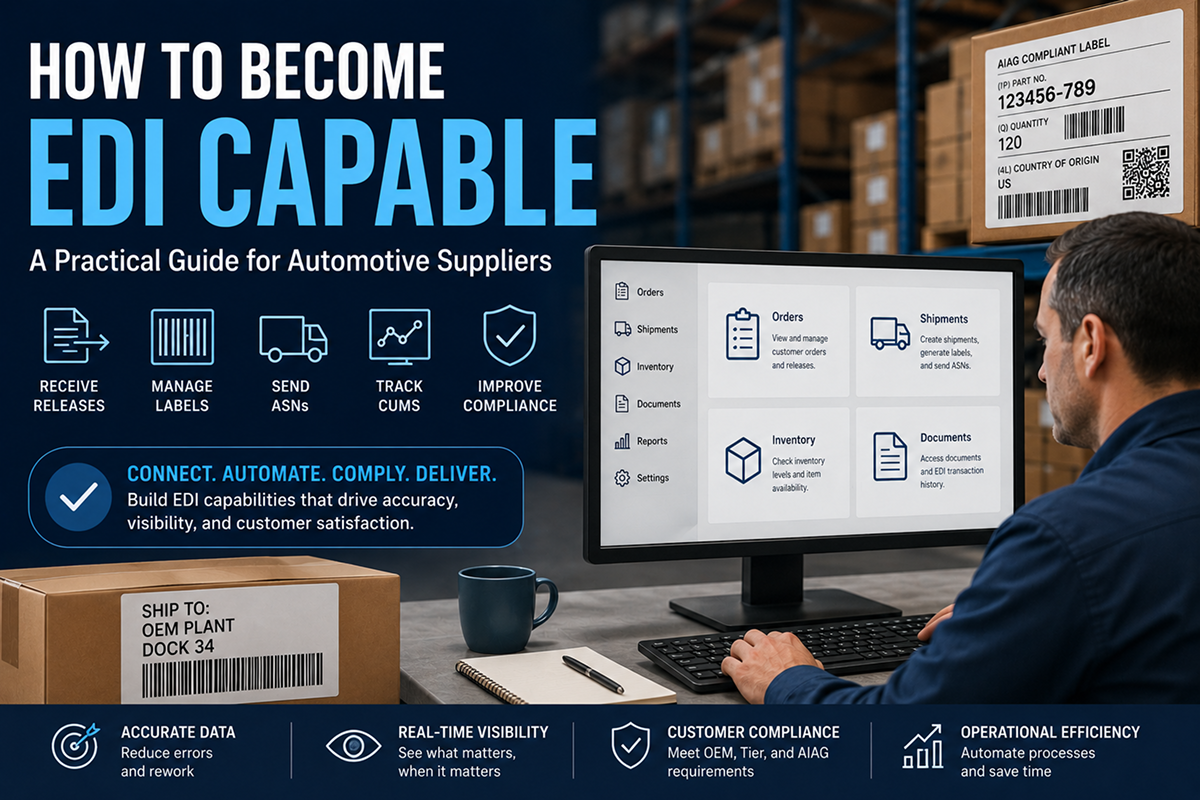
How to Become EDI Capable: A Guide for Automotive Suppliers
You usually don’t hear the phrase “EDI capable” when everything is calm.
It tends to show up when a customer is onboarding you, a new program is starting, or someone from purchasing sends a short email that says something like, “Please confirm your company is EDI capable.” Nice and simple. Except it isn’t simple at all.
For automotive suppliers, being EDI capable is not just about having a piece of software that can receive a file. That’s the easy part. The harder part is making sure that file turns into the right demand, the right shipment, the right barcode label, the right ASN, and the right customer communication — without someone in shipping having to perform spreadsheet gymnastics at 4:45 on a Friday.
That’s where the real work begins.
What Does EDI Capable Mean?
Let’s start with a plain-English EDI capable definition.
Being EDI capable means your business can electronically send, receive, process, and respond to required business documents in the format your customers or suppliers expect. In other words, your systems can talk to their systems without someone manually typing everything from one screen into another.
But in automotive, the EDI capable meaning gets heavier. Much heavier.
An automotive supplier may need to receive 830 material releases, 862 shipping schedules, 850 purchase orders, and other customer documents, then send back 856 ASNs, 810 invoices, acknowledgments, and customer-specific data. And those documents don’t live in a neat little vacuum. They affect production, inventory, shipping, labeling, CUM tracking, customer scorecards, and sometimes whether your shipment gets accepted at the dock.
So, what does EDI capable mean for an automotive supplier?
It means your company can handle the electronic communication and the business logic behind it.
That second part matters.
EDI Capabilities Meaning: It’s More Than Translation
A lot of people hear “EDI” and think “document translation.” Fair enough. That is part of it.
But the full EDI capabilities meaning goes beyond converting one file format into another. A supplier may technically receive an EDI document and still not be truly ready to use it in a reliable, operational way.
Think of it like getting a box of parts with no labels, no work instructions, and no clue where half of it goes. Technically, you received it. Great. Now what?
True EDI capabilities should help your team understand what the customer is asking for, what has already shipped, what still needs to ship, which dates matter, what labels are required, and whether the ASN will pass before the truck leaves the lot.
That’s the difference between “we got the EDI file” and “we’re actually EDI capable.”
Why Automotive Suppliers Can’t Treat EDI Like a Side Project
In some industries, EDI is mostly about purchase orders and invoices. Important, yes, but not always operationally explosive.
Automotive is different. Naturally.
Customer releases shift. Ship schedules change. CUMs need to stay aligned. Dock codes, line feed locations, RAN numbers, Kanban signals, standard pack rules, and customer-specific barcode labels all have to be interpreted correctly. Miss one tiny piece and suddenly a normal shipment turns into a fire drill.
And nobody enjoys those.
For suppliers working with OEMs and Tier customers, EDI capability is tied directly to shipping performance, customer satisfaction, and compliance expectations like MMOG/LE and IATF 16949. It’s not just an IT requirement. It’s part of how the business proves it can operate with discipline.
A supplier that can’t manage EDI cleanly may still make great parts. Beautiful parts, even. But if the labels are wrong or the ASN rejects, the customer experience still suffers.
How to Become EDI Capable
There isn’t one single path to becoming EDI capable, but there is a sensible order to things.
Start with your customer requirements. Before choosing software or calling vendors or making a heroic spreadsheet, find out exactly what your customer expects. Which EDI documents? Which versions? Which communication method? Which labels? Which ASN rules? Which testing process?
It sounds obvious. It gets skipped all the time.
A customer may say they require EDI, but the details are where the thorns are. One customer may require an 856 ASN within a specific window. Another may need exact barcode serial data. Another may send cumulative quantities that must be reconciled before planning and shipping can happen safely.
So the first step is not “buy EDI.” The first step is “understand the obligation.”
Choose the Right EDI Approach
Not every supplier needs the same setup.
A very small supplier with one customer might start with a web portal. It’s not glamorous, and it can be tedious, but sometimes it works as a temporary bridge. The problem is that portals usually mean manual entry, and manual entry has a bad habit of becoming manual correction, then manual blame, then manual panic.
For growing automotive suppliers, a more complete EDI solution is usually needed. That might be a standalone EDI translator, a managed EDI provider, an ERP-integrated EDI setup, or an automotive-specific order management system.
Generic EDI can move transactions. But automotive suppliers need more than movement. They need context. CUM logic, standard pack rounding, ship schedules, ASNs, barcode labels, releases, and customer-specific rules all need to work together. Otherwise, the EDI may arrive just fine while the rest of the operation is still left wrestling the bear.
Connect EDI to Your ERP and Daily Workflow
EDI should not live in a lonely corner of the business.
If EDI comes in but your team still has to re-key demand into ERP, manually update spreadsheets, print labels from another tool, and then build ASNs somewhere else, you may be “EDI enabled” in the thinnest possible sense. But you’re not getting the real value.
Your EDI process should connect to order management, production planning, inventory, shipping, labeling, invoicing, and reporting. The data should flow with purpose. Cleanly. Predictably. Without three people asking, “Did anybody update the file?”
This is especially important when customer demand changes. A schedule update should not require detective work. Your team should be able to see what changed, what matters, and what needs action.
Build Around Accurate Barcode Labeling and ASNs
For automotive suppliers, barcode labeling and ASNs are where EDI capability becomes very visible.
If a label is wrong, the customer sees it. If an ASN fails, the customer sees it. If a shipment arrives with the wrong data attached to the right parts — which is somehow even more frustrating — the customer sees that too.
Being EDI capable means your system should support customer-specific labels, AIAG-compliant formats, serial label data, master labels, mixed labels when needed, and the information required to produce an accurate ASN.
This is one of those areas where “close enough” is not really close enough.
A label that scans correctly for one customer may be wrong for another. A ship-to location may require one format while another destination under the same customer requires something slightly different. Automotive suppliers live in those details, and the software needs to live there too.
Don’t Forget CUM Tracking
CUM tracking is one of those automotive terms that sounds small until it causes a mess.
Cumulative accounting helps determine what the customer has required, what the supplier has shipped, and where the numbers stand over time. When CUMs are wrong, the downstream problems can be ugly: over-shipping, under-shipping, past-due quantities, customer disputes, premium freight, and long conversations nobody wanted to have.
A supplier trying to become EDI capable should ask a blunt question: can our process manage customer CUM required, supplier CUM shipped, and customer CUM received without manual guesswork?
If the answer is “mostly,” that’s usually a warning light.
Maybe not a full dashboard of flashing red lights. But at least one of those little amber ones you shouldn’t ignore.
Validate Shipments Before They Leave
The best time to catch a shipping problem is before the shipment leaves the dock.
Obvious? Sure. Still worth saying.
Once the truck is gone, every fix gets more expensive. Wrong label. Missing ASN data. Incorrect quantity. Mismatched container. Wrong ship-to. These things are not just clerical issues; they can affect customer scorecards, receiving performance, and your team’s credibility.
That’s why EDI capability should include validation. Ideally, your shipping process should confirm that labels, quantities, containers, paperwork, and ASN data line up before anything ships.
Scan verification is a practical way to do this. Not fancy. Just practical. The system checks what was supposed to ship against what was actually scanned, packed, labeled, and staged.
That’s how you avoid the “wait, what went out?” moment.
Monitor Exceptions and Acknowledgments
EDI is not finished when you send the document.
You also need to know whether the customer received it, accepted it, rejected it, or sent back an error. A 997 acknowledgment may confirm receipt. An 824 may tell you there is an application-level problem. Other customer-specific messages may require action from your team.
If nobody is watching those responses, you’re flying half-blind.
A strong EDI process should include alerts, dashboards, reports, or at least a clear daily routine for reviewing exceptions. And not just by IT. Materials, shipping, customer service, and operations may all need visibility depending on the issue.
Because sometimes the problem is technical.
Sometimes it’s a business rule.
And sometimes it’s just the customer saying, in their own electronic way, “Nope, try again.”
EDI Capable Checklist for Automotive Suppliers
Before you tell a customer you’re fully EDI capable, it helps to pressure-test the basics.
Can you receive and process required inbound documents? Can you send ASNs and invoices? Can your team manage acknowledgments and errors? Can EDI data flow into your ERP or order management process without manual re-entry?
Then look at the automotive layer.
Can you manage releases and shipping schedules? Can you handle CUM tracking? Can you create customer-specific AIAG barcode labels? Can you validate shipment data before ASN transmission? Can you support standard pack, dock codes, RANs, Kanban, and ship-to logic where required?
And finally, ask the uncomfortable process questions.
Who owns exceptions? Who updates customer requirements? Who tests new trading partners? Who confirms that label changes are handled? Who notices when an ASN fails after hours?
If the answers are fuzzy, the process probably is too.
Common Mistakes When Becoming EDI Capable
The first mistake is treating EDI as just an IT project.
Yes, IT matters. Of course it does. But EDI touches the whole order-to-ship process, and the people who live in that process need to be involved. Materials. Shipping. Customer service. Quality. Finance. Sometimes even the plant manager, especially when customer scorecards are on the line.
The second mistake is building around manual workarounds.
A workaround feels harmless in the beginning. One spreadsheet. One manual label adjustment. One person who “just knows” how that customer works. Then that customer changes a requirement, the person goes on vacation, and the whole thing starts wobbling like a shopping cart with one bad wheel.
The third mistake is assuming all EDI solutions are basically the same.
They aren’t.
For automotive suppliers, the difference between generic EDI and automotive-specific EDI can be the difference between simply moving data and actually running a controlled, compliant shipping process.
How AIM Helps Automotive Suppliers Become EDI Capable
AIM Computer Solutions works with automotive production part suppliers that need EDI to do more than pass documents back and forth.
AIM solutions are built around the realities of automotive supply chain operations: customer releases, CUM tracking, AIAG-compliant barcode labels, ASNs, shipping validation, ERP integration, and compliance expectations like MMOG/LE and IATF 16949.
For suppliers that already have an ERP system in place, AIM AutoSys can provide automotive-specific EDI, order management, barcode labeling, shipping, ASN, and release accounting capabilities. It helps suppliers manage complex OEM and Tier requirements without forcing them to turn their ERP into a maze of customizations.
For suppliers using Epicor, AIM AutoCOR adds automotive EDI order management, labeling, shipping, and ASN control while keeping Epicor as the core ERP system.
For suppliers that need a complete automotive ERP platform, AIM Vision brings together ERP, EDI, barcode labeling, inventory, production, traceability, shipping, and shop-floor visibility in one system designed for automotive manufacturing.
Different situations. Different fit. Same point: automotive EDI needs automotive logic.
Becoming EDI Capable Is Really About Control
At the end of the day, becoming EDI capable is not just about checking a box for a customer.
It’s about control.
Control over demand. Control over labels. Control over CUMs. Control over shipments. Control over the ASN before it turns into a customer complaint.
For automotive suppliers, that control matters every single day. Not once a year during an audit. Not only when onboarding a new customer. Every shift, every shipment, every time customer demand changes and your team has to respond without tripping over disconnected systems.
So when someone asks, “Are you EDI capable?” the best answer is not just “yes.”
The better answer is: “Yes — and our process can prove it.”
Ready to evaluate your EDI capabilities?
Schedule a workflow review with AIM to identify where your current release, labeling, ASN, CUM tracking, or shipping process may be creating risk.