What Is an EDI VAN? & Why It Matters for Automotive Suppliers
An EDI VAN is one of those terms that gets used often but not always explained clearly.
For automotive suppliers, that matters. EDI is not just a back-office function. It drives releases, shipping schedules, barcode labels, ASNs, invoices, and customer compliance.
So, what is an EDI VAN?
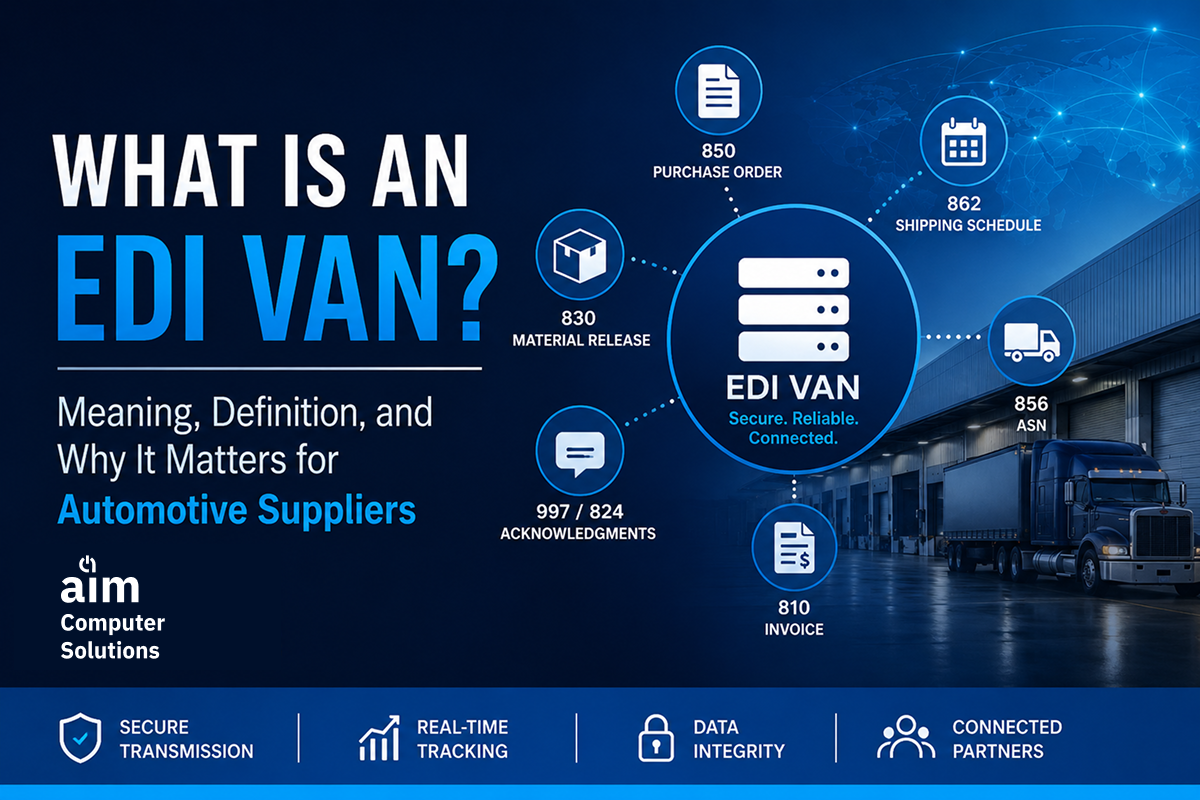
An EDI VAN, or Electronic Data Interchange Value-Added Network, is a secure third-party network that helps companies exchange EDI documents with trading partners. It acts like a managed electronic mailbox, routing documents between customers, suppliers, OEMs, and Tier partners.
That’s the basic definition.
But in automotive, moving the document is only the beginning.
EDI VAN Definition
An EDI VAN is a value-added network used to send, receive, route, store, and track EDI documents between trading partners.
Common automotive EDI documents sent through a VAN include:
- 830 Material Releases
- 862 Shipping Schedules
- 850 Purchase Orders
- 860 Purchase Order Changes
- 856 Advance Ship Notices
- 810 Invoices
- 997 Functional Acknowledgments
- 824 Application Advice messages
Instead of building a separate direct connection to every customer or supplier, companies can use a VAN to manage EDI communication through one network.
What Is an EDI VAN? Why Automotive Suppliers Need to Know the Difference
Most automotive suppliers have a VAN. Not all of them know exactly what it’s doing — or more importantly, what it isn’t doing.
An EDI VAN, or Value-Added Network, is a secure third-party network that routes EDI documents between trading partners. Think of it as a managed electronic mailbox: your customer sends an 830 release or an 862 shipping schedule, the VAN receives it, and your EDI system picks it up. Outbound documents — 856 ASNs, 810 invoices, 997 acknowledgments — travel back the same way.
For automotive suppliers working with Ford, GM, Stellantis, Honda, Toyota, and Tier customers, that secure routing is a necessary foundation. EDI isn’t optional when your customer mandates it, and a VAN makes it possible to exchange documents with dozens of trading partners without building a separate direct connection to each one.
But a VAN is infrastructure, not intelligence.
It delivers the data. What happens next — CUM accounting, standard pack rounding, AIAG label generation, ASN validation, 824 error resolution — that requires automotive EDI logic your VAN was never designed to provide.
That distinction matters more than most suppliers realize. Until an ASN gets rejected.
How Does an EDI VAN Work?
A typical EDI VAN process looks like this:
- A customer sends an EDI document, such as an 830 or 862.
- The VAN receives and routes the document.
- The supplier’s EDI system retrieves it.
- The EDI software translates the file into usable business data.
- The supplier processes demand, ships product, and sends return documents.
- The VAN delivers outbound documents, such as an 856 ASN or 810 invoice, back to the customer.
The VAN is the delivery lane.
The supplier still needs the right system to interpret the data correctly and use it across order management, labeling, shipping, and ERP workflows.
EDI VAN vs. Direct EDI Connection
A VAN routes documents through a third-party network. A direct EDI connection links two trading partners without one. Some suppliers use a VAN exclusively. Some use direct connections for specific customers. Many use both.
Neither approach is wrong. The question worth asking isn’t which one you’re using — it’s what your system does with the data after it arrives.
A supplier can receive a clean 862 shipping schedule through a VAN or a direct connection and still stage the wrong quantity, generate the wrong label, or send an ASN that bounces back with an 824. The connectivity method didn’t cause that problem. The automotive EDI logic — or the lack of it — did.
That’s where the real evaluation starts.
Why Automotive Suppliers Use EDI VANs
Automotive suppliers use EDI VANs because they need secure, trackable communication with many trading partners.
A VAN can help suppliers:
- Exchange documents with multiple OEMs and Tier customers
- Track whether documents were sent and received
- Manage inbound and outbound EDI traffic
- Support standardized business communication
- Reduce manual document handling
For suppliers working with Ford, GM, Honda, Toyota, Stellantis, and Tier customers, a VAN can be an important part of the EDI process.
But it is not the whole process.
Where an EDI VAN Falls Short
A VAN moves documents. It does not solve every automotive EDI problem.
By itself, an EDI VAN does not usually handle:
- CUM tracking
- Release accounting
- Standard pack rounding
- Customer-specific AIAG labels
- ASN validation
- Dock-level scan verification
- Kanban or RAN logic
- ERP integration gaps
- MMOG/LE or IATF 16949 process control
That distinction matters.
A supplier can receive the EDI file successfully and still ship the wrong quantity, print the wrong label, or send an ASN that gets rejected.
Why Automotive EDI Requires More Than a VAN
Automotive EDI is not just document exchange. It is operational instruction.
An 830 release can affect purchasing and production.
An 862 schedule can affect what gets pulled, packed, labeled, and shipped.
An 856 ASN can affect whether the customer accepts the shipment cleanly.
Small details carry real risk.
A missing dock code, bad CUM, wrong label format, or incomplete ASN can create chargebacks, rework, expedited freight, and customer scorecard issues.
That is why automotive suppliers need more than basic EDI transport. They need software that understands OEM and Tier requirements before those requirements hit the dock.
How AIM Helps Automotive Suppliers Go Beyond the VAN
A VAN moves the document. AIM makes the data usable — connected to order management, labeling, shipping, and ERP workflows that have to work correctly every time a truck leaves the dock.
If your ERP is SAP, Oracle, Infor, or another system that wasn’t built for automotive EDI complexity — AIM AutoSys adds the release accounting, CUM tracking, AIAG labeling, ASN validation, and customer-specific shipping logic your ERP doesn’t handle. It connects to 535+ trading partners and supports OEM and Tier requirements for Ford, GM, Stellantis, Toyota, Honda, and more. No custom mapping required every time a customer changes a requirement.
If you’re running Epicor and dealing with ASN rejections, label rework, or customer demand that doesn’t flow cleanly into your system — AIM AutoCOR embeds automotive order management, AIAG labeling, CUM tracking, and outbound ASN processing directly into Epicor. Your team stops rebuilding labels by hand and starts shipping with confidence.
If you want to keep your current ERP but need cleaner automotive EDI intelligence feeding into it — AIM AutoConnect handles the CUM logic, ship codes, transit days, standard pack rules, and ASN processing, then sends clean net demand into your ERP instead of raw EDI complexity.
If you need a full ERP built around automotive production — AIM Vision ERP connects EDI, inventory, production, barcode labeling, shipping, receiving, and compliance in one system designed specifically for repetitive automotive manufacturers.
Different situations. Same result: the data your VAN delivers actually drives the right labels, the right ASNs, and the right shipments.
Questions to Ask Before Choosing an EDI VAN or EDI Solution
Before choosing a VAN or reviewing your current EDI setup, ask:
- Which OEMs and Tier customers do we need to support?
- Do we use a VAN, direct connections, or both?
- Can our ERP interpret automotive EDI correctly?
- Are we managing CUMs manually?
- Do we struggle with ASN rejections or 824 errors?
- Can we generate customer-specific AIAG labels automatically?
- Can plant teams resolve their own EDI exceptions?
- Do we validate shipment data before the truck leaves?
- Are our processes ready for MMOG/LE and IATF 16949 expectations?
These questions help separate basic EDI connectivity from true automotive EDI execution.
The Bottom Line
An EDI VAN is an important part of electronic communication. It helps trading partners exchange EDI documents securely and reliably.
But for automotive suppliers, document delivery is only the first step.
The real challenge is turning EDI into accurate demand, compliant labels, clean ASNs, correct shipments, reliable CUM tracking, and repeatable processes.
That is where AIM fits.
AIM helps automotive suppliers manage EDI complexity from release through shipment, with automotive-specific logic built for OEM and Tier requirements.
Ready to review your EDI, labeling, and ASN workflow?
If your VAN is delivering documents but your team is still chasing CUM discrepancies, rebuilding labels, or resolving 824 errors — the problem isn’t the VAN. It’s what happens after the data arrives.
Talk to an AIM specialist about your specific OEM and Tier requirements. Request a workflow review — not a product pitch.
See how AIM handles your supply chain from release through shipment.