
AIAG Labeling Software for Automotive Suppliers
AIAG labeling refers to the standardized barcode labeling requirements defined by the Automotive Industry Action Group to ensure consistent identification, tracking, and traceability of automotive parts throughout the supply chain.
An AIAG automotive label must follow specific formats and data rules—such as those defined in the AIAG label standard—so OEMs, Tier suppliers, and logistics partners can accurately receive, scan, and process shipments without disruption.
Meeting those requirements in the real world is rarely simple. Automotive suppliers must account for OEM-specific interpretations, frequent label updates, cumulative data, and tight integration with shipping and EDI processes.
AIM’s AIAG labeling software is purpose-built to manage that complexity automatically, applying the correct labeling rules at the point of shipment so labels, ASNs, and customer requirements stay aligned.
- Enforce AIAG and OEM label rules automatically with built-in validation for container, master, and mixed labels
- Eliminate ASN rejections and relabeling by aligning labels, shipments, and EDI data before product leaves the dock
- Stay audit-ready for MMOG/LE and IATF 16949 with a complete digital trail for labeling and shipping activity
Why AIAG Labeling Is Challenging in the Real World
AIAG labeling standards are designed to bring consistency to the automotive supply chain—but real-world OEM requirements, customer variations, and manual processes often make compliance far more complex than it appears.
AIAG Standards vs. OEM Reality
AIAG labeling standards provide a framework, but OEMs and Tier customers frequently add their own interpretations and requirements. What passes for one customer may be rejected by another, even when both reference the same AIAG label standard.
Customer-Specific Variations Multiply Quickly
As suppliers add new programs, plants, or customers, AIAG automotive labeling becomes harder to manage. Different barcode formats, data rules, container hierarchies, and destination requirements increase complexity with every shipment.
Manual Processes Create Risk
Cumulative accounting is critical in automotive, but difficult to manage without automation. When CUMs are tracked manually or outside the order system, discrepancies quickly lead to past-due quantities, over-shipments, customer disputes, and audit findings.
Labels, ASNs, and Orders Must Match
AIAG labels don’t exist in isolation. If label data doesn’t align with orders, cumulative quantities, and ASNs, problems surface at the customer dock. Without validation before shipment, errors are often discovered too late to fix.
How AIM’s AIAG Labeling Software Solves These Challenges
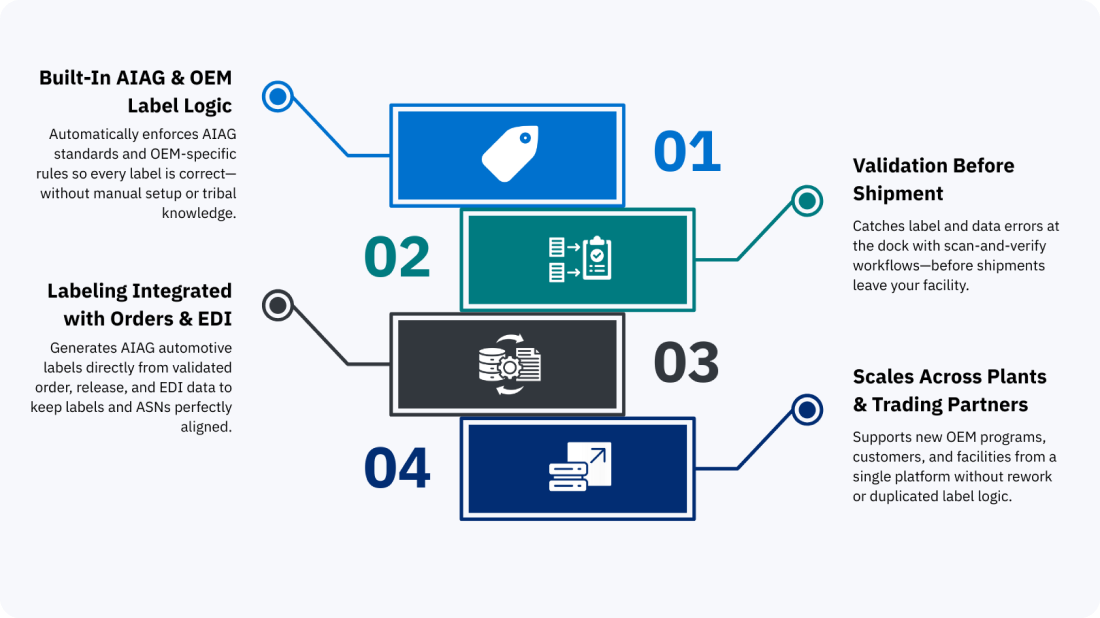
Designed specifically for automotive production environments, AIM’s AIAG labeling software embeds automotive business logic directly into the labeling and shipping process—so compliance is enforced automatically, not manually.
Built-In AIAG and OEM Label Logic
AIM applies AIAG label standards alongside OEM- and customer-specific rules automatically. Label formats, required data elements, and barcode structures are enforced by the system, eliminating guesswork and reducing reliance on tribal knowledge.
Labeling Integrated with Orders and EDI
AIAG automotive labels are generated directly from validated order, release, and EDI data. This ensures label content stays synchronized with ASNs, cumulative quantities, and shipping documentation—preventing downstream mismatches.
Validation Before Shipment
Labels are validated before product leaves the dock using scan-and-verify workflows. Errors are caught early, allowing teams to correct issues before shipments are transmitted or received by the customer.
Scales Across Plants and Trading Partners
Whether you’re adding new OEM programs, onboarding customers, or expanding to additional plants, AIM’s solution scales without rework. Automotive suppliers can manage multiple label formats and customer rules from a single, consistent platform.
AIAG Label Formats Supported
AIM’s AIAG labeling software supports the full range of AIAG automotive label formats required by OEMs and Tier customers. Each label type is generated using embedded business rules to ensure accuracy, consistency, and compliance—without manual setup or ongoing maintenance.
AIAG B-10 container labels are the foundation of automotive shipping identification, and even small errors can result in rejected shipments. AIM automatically generates AIAG B-10–compliant container labels using live order, release, and packaging data, ensuring that required fields, barcode symbology, and data structure follow both AIAG standards and customer-specific interpretations.
Because the system is driven by automotive business logic rather than static templates, updates to customer requirements or AIAG standards can be applied without reworking label layouts or manual intervention—keeping container labels accurate as programs evolve.
When multiple containers are consolidated into a single shipment, master and mixed load labels become critical for customer receiving and ASN reconciliation. AIM’s solution automatically builds and manages label hierarchies, ensuring that parent and child labels remain synchronized with actual shipment contents.
Quantities, container relationships, and serial data are validated as labels are created, reducing the risk of mismatches between what is shipped, what is labeled, and what is transmitted electronically. This approach supports both standard and complex shipping scenarios without requiring custom label logic per customer.
While AIAG standards define a baseline, most OEMs and Tier customers apply additional rules based on destination, dock, or program. AIM’s AIAG labeling software supports these variations automatically by layering customer-specific requirements on top of the AIAG label standard.
Destination codes, dock locations, ship-to data, and required reference fields are applied dynamically based on order and EDI data. This allows suppliers to support multiple customers and destinations without maintaining separate label templates or risking outdated configurations.
Automotive suppliers managing returnable and expendable container programs need accurate labeling to maintain visibility and accountability. AIM supports both container types by generating labels that integrate with container tracking, cumulative accounting, and shipping workflows.
Label data is tied directly to shipment and inventory transactions, supporting better reconciliation of container balances and reducing disputes with customers. This integrated approach helps suppliers maintain control over container programs while staying compliant with AIAG and OEM requirements.
With built-in support for thousands of automotive label formats, AIM helps suppliers stay compliant today while remaining flexible for future OEM and AIAG changes.
Prevent ASN Rejections with Built-In Label Validation
Even when labels look correct, mismatches between label data, ASNs, and shipment contents are one of the leading causes of rejected shipments in the automotive supply chain. AIM’s AIAG labeling software closes that gap by validating labels as part of the shipping process—before data is transmitted and before trucks leave the dock.
By embedding validation into daily workflows, suppliers can catch issues early, correct them quickly, and ship with confidence knowing labels, ASNs, and customer requirements are fully aligned.
With built-in validation, automotive suppliers can:
- Verify label accuracy before shipment using scan-and-verify workflows at the dock
- Ensure labels, ASNs, and order data match to prevent downstream receiving errors
- Catch customer-specific exceptions early instead of reacting to 824s or chargebacks
- Reduce relabeling and rework caused by late-stage errors or missed requirement changes
- Improve supplier scorecards with higher ASN acceptance rates and on-time delivery
Built for Automotive Compliance and Audit Readiness
AIAG labeling is not just a shipping requirement—it is a core component of broader automotive compliance expectations. AIM’s AIAG labeling software is designed to support suppliers operating under strict quality and audit standards by ensuring labeling, shipping, and electronic transactions follow documented, repeatable processes.
By embedding compliance into daily operations, AIM helps suppliers move away from manual checks and reactive fixes toward a controlled, audit-ready environment that stands up to OEM scrutiny.
AIM supports automotive compliance by helping suppliers:
- Meet AIAG labeling requirements consistently across customers, plants, and programs
- Support MMOG/LE expectations for electronic data exchange, shipping accuracy, and traceability
- Align with IATF 16949 requirements by reducing nonconformances tied to labeling and shipping errors
- Maintain a digital audit trail for labels, ASNs, and shipment validation activities
- Respond confidently to OEM audits with documented processes instead of spreadsheets and screenshots
How AIM Fits Into Your Existing Systems
AIAG labeling doesn’t operate in isolation—it must work seamlessly with your ERP, EDI, and shipping workflows. AIM’s solutions are designed to integrate cleanly into automotive environments without forcing ERP customization or disconnected processes.
Works with Your ERP Environment
AIM’s AIAG labeling software integrates with leading ERP systems used by automotive suppliers, including SAP, Epicor, and other enterprise platforms. Label data is driven directly from trusted system-of-record information, reducing manual entry and ensuring consistency across orders, shipments, and ASNs.
Built for Automotive EDI Workflows
Label generation is tightly aligned with inbound and outbound EDI transactions. Customer releases, ship schedules, cumulative data, and ASN requirements all feed the labeling process, ensuring every AIAG automotive label reflects the same data transmitted electronically.
Flexible Deployment Options
AIM supports multiple deployment paths depending on your operation. Suppliers can implement AIAG labeling as a standalone solution alongside an existing ERP, integrate it with Epicor using AIM AutoCOR, or leverage it as part of the AIM Vision ERP platform.
Scales Across Plants and Programs
Whether you operate a single facility or multiple plants across regions, AIM’s architecture supports centralized control with plant-level execution. New customers, destinations, and OEM programs can be added without reworking integrations or rebuilding label logic.
AIAG Labeling Software FAQs
These are some of the most common questions automotive suppliers ask when evaluating AIAG labeling software and preparing for OEM compliance.
An AIAG Label is a standardized automotive barcode label defined by the Automotive Industry Action Group to ensure accurate identification, tracking, and traceability of parts throughout the supply chain. OEMs require AIAG Labels so shipments can be scanned, validated, and received without errors—supporting ASN acceptance, MMOG/LE and IATF 16949 compliance, and audit readiness. Incorrect or missing AIAG Labels often lead to shipment rejections, chargebacks, and supplier scorecard issues.
AIM supports current AIAG labeling standards, including AIAG B-10 container labels, along with master, mixed load, and customer-specific label formats. The system applies AIAG standards in combination with OEM and Tier customer requirements to ensure labels are compliant in real-world shipping scenarios.
While AIAG provides a standard framework, OEMs often apply additional rules. AIM’s AIAG labeling software embeds OEM- and customer-specific logic directly into the labeling process, automatically applying destination, dock, and program-specific requirements without manual label maintenance.
Yes. AIM’s AIAG labeling software can integrate with common ERP systems used by automotive suppliers, including SAP and Epicor, or operate as part of the AIM Vision ERP platform. Label data is driven directly from your system of record to ensure consistency across orders, shipments, and ASNs.
AIM validates labels as part of the shipping workflow, ensuring label data matches order, shipment, and ASN information before transmission. Errors are identified early through scan-and-verify processes, reducing the likelihood of rejected ASNs and customer chargebacks.
Yes. AIM is designed to support both single-plant and multi-plant automotive suppliers. The system allows centralized control of labeling logic while enabling plant-level execution, making it easier to scale across locations, customers, and OEM programs.
Take the Risk Out of AIAG Label Compliance
If AIAG Label errors are driving ASN rejections, relabeling, or audit findings, AIM helps automotive suppliers enforce compliance before shipments leave the dock. By embedding AIAG and OEM-specific labeling rules directly into shipping workflows, AIM ensures labels, ASNs, and shipment data stay aligned—reducing risk, protecting supplier scorecards, and supporting audit-ready operations.
Schedule a demo to see how AIM simplifies AIAG labeling and protects your shipments—before they leave the dock.
