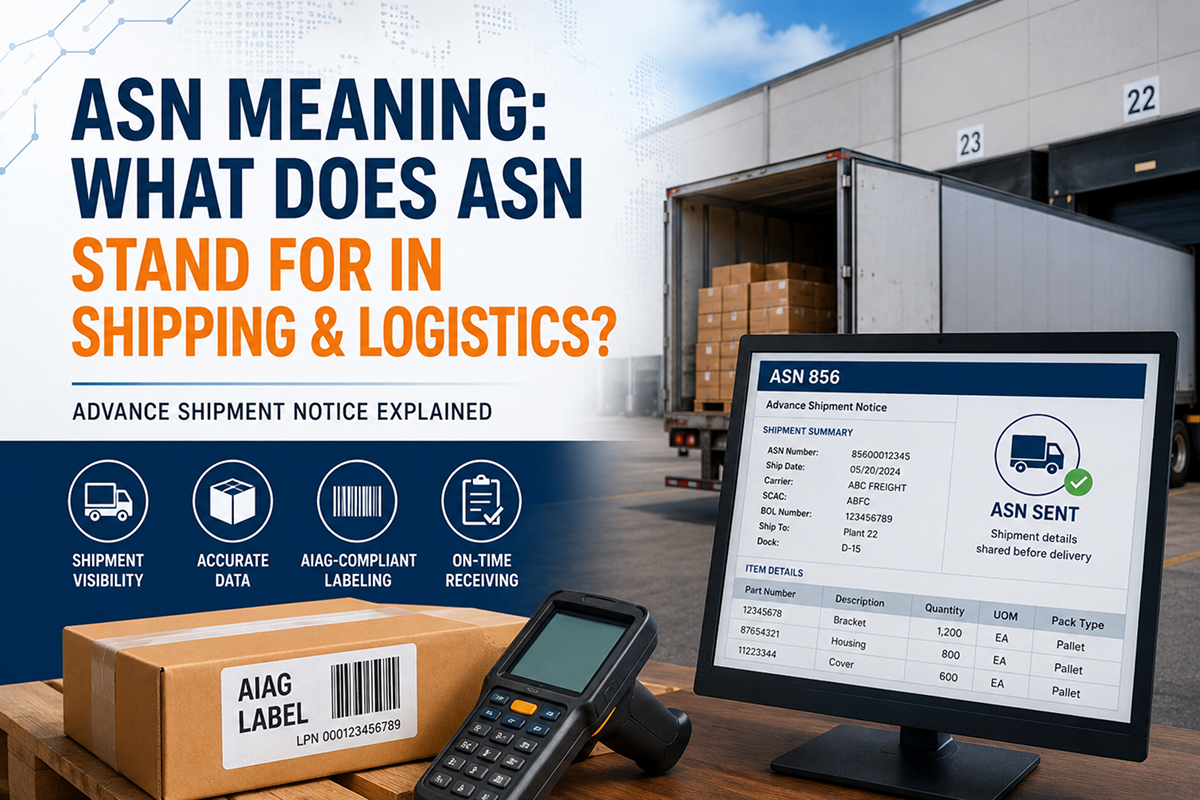
ASN Meaning: What Does ASN Stand For in Shipping and Logistics?
A truck can be packed perfectly, sealed, and rolling out of the dock on time—and still cause a headache before it hits the road.
That sounds odd, but anyone who has lived around automotive shipping knows it’s true. The parts may be right. The labels may look fine. The driver may be waiting with the trailer door closed. But if the ASN is late, wrong, incomplete, or flat-out rejected, the shipment can turn into a mess fast.
So let’s start there.
ASN stands for Advance Shipment Notice. In shipping and logistics, an ASN is an electronic message that tells the customer what is being shipped before the shipment arrives.
Simple enough.
Well… mostly.
What Does ASN Stand For?
ASN stands for Advance Shipment Notice.
You may also hear people call it an Advanced Shipping Notice, and, sure, most people will know what you mean. But in EDI and automotive supply chain conversations, Advance Shipment Notice is the cleaner term.
An ASN gives the receiving customer a preview of the shipment: parts, quantities, packaging, ship-from location, ship-to destination, carrier details, shipment timing, and sometimes barcode serial numbers or container information.
In EDI terms, the ASN is commonly tied to the EDI 856 Ship Notice/Manifest transaction. AIM AutoCOR, for example, supports transaction sets including 830 Material Release, 862 Shipping Schedule, 856 Advanced Shipment Notification, 810 Invoice, 997 Functional Acknowledgement, and 824 Application Advice.
ASN Meaning in Shipping
In shipping, an ASN is the customer’s heads-up.
It says, essentially: “Here’s what left our dock, here’s how it’s packed, here’s when it shipped, and here’s what you should expect when it gets there.”
That matters because receiving teams don’t want surprises. Nobody wants to crack open a trailer and then start guessing which release, purchase order, dock code, or shipment schedule the material belongs to. That’s a recipe for delays, finger-pointing, and someone staying late on a Friday.
A good ASN helps the customer receive material faster and with fewer questions. A bad ASN? That’s where things get expensive.
ASN Meaning in Logistics
In logistics, the ASN is less like a shipping document and more like a traffic signal.
It helps receiving plants, warehouses, and cross-docks prepare before the material arrives. The customer can plan dock space, verify carrier information, update inbound inventory expectations, and spot issues before they become dock-floor chaos.
This is especially important in automotive, where freight, packaging, labels, cumulative quantities, and customer-specific rules all get tangled together. AIM materials describe automotive suppliers as needing to manage complex EDI, release accounting, AIAG-compliant barcode labeling, ASNs, shipping paperwork, CUM tracking, inventory accuracy, and MMOG/LE / IATF 16949 compliance.
That’s not just paperwork.
That’s the nervous system of the supply chain.
What Information Is Included in an ASN?
An ASN usually includes shipment-level and item-level details.
That may sound dry, but the details matter. One wrong digit in a part number, one missing packing slip reference, one mismatched barcode serial number, and suddenly a clean shipment looks suspicious to the customer’s system.
Common ASN data may include:
- ASN or shipment number
- Ship date and time
- Carrier and SCAC code
- Bill of lading number
- Packing slip number
- Ship-from and ship-to locations
- Customer part number
- Supplier part number
- Purchase order, release, RAN, or Kanban reference
- Quantity shipped
- Unit of measure
- Container, pallet, or package details
- Serial label numbers
- Returnable container details
Not every customer asks for the exact same thing. That’s part of the fun—and by “fun,” I mean the part that makes EDI coordinators mutter into their coffee.
ASN vs. Packing Slip
A packing slip rides with the shipment.
The ASN travels electronically.
That’s the big difference. A packing slip is usually printed and placed with the freight. An ASN is sent through EDI so the customer’s system can receive shipment data before the truck arrives.
In a perfect world, the packing slip, barcode labels, ASN, and physical shipment all tell the same story. Same part. Same quantity. Same destination. Same packaging logic.
When they don’t, the customer notices.
ASN vs. Bill of Lading
A bill of lading is tied to transportation.
It documents the movement of goods between the shipper and the carrier. It helps identify freight, carrier responsibility, shipment terms, and delivery handling.
The ASN, on the other hand, is for the customer’s receiving and supply chain systems. It tells the customer what was shipped in a structured electronic format.
Both matter. They just do different jobs.
ASN vs. Invoice
An invoice asks for payment.
An ASN confirms shipment details.
That distinction matters, especially in automotive environments where shipment data, receiving data, and payment processes can be closely connected. If the ASN doesn’t match what the customer expects—or what actually shows up—then payment, scorecards, and receiving accuracy can all get dragged into the mud.
Not always. But often enough.
How ASNs Work in EDI
The ASN usually comes near the end of the order-to-ship process, but it depends on everything that happened before it.
First, the customer sends demand. That might be an 830 Material Release, 862 Shipping Schedule, 850 Purchase Order, or another EDI transaction. Then the supplier builds, packs, labels, and stages the shipment.
Once the shipment is ready—or when it leaves the dock—the supplier sends the ASN, often as an EDI 856.
After that, the customer may send acknowledgments or error messages. A 997 Functional Acknowledgment can confirm receipt of the EDI transmission, while an 824 Application Advice can flag business-level problems in the data. AIM AutoSys materials specifically reference 997/824 monitoring dashboards that help flag exceptions before they delay shipments.
And that’s the part people sometimes miss: sending the ASN is not the same as having it accepted cleanly.
Why ASNs Matter So Much in Automotive
In automotive, an ASN is not a courtesy note.
It’s a compliance checkpoint.
OEMs and Tier customers rely on accurate shipment data to keep production moving. If a supplier ships the wrong quantity, uses the wrong label format, misses a required dock code, or sends an ASN after the freight arrives, that customer may have to slow down receiving, correct records manually, or escalate the issue.
The ASN is where shipping accuracy becomes visible.
AIM AutoSys is built specifically for automotive production part suppliers to manage EDI, barcode labeling, and shipping processes while supporting MMOG/LE and IATF 16949 compliance. Its product materials describe capabilities for 856 ASNs, packaging logic, CUM quantities, barcode labeling, and customer-specific trading partner requirements.
That’s why suppliers don’t treat ASNs like a back-office afterthought. Or at least, they shouldn’t.
Common ASN Errors That Cause Trouble
Some ASN mistakes are obvious. Wrong part number. Wrong ship-to. Wrong quantity.
Others are sneakier.
A shipment can be physically correct but electronically wrong. That’s the nasty one. The dock team did its job, the labels printed, the truck left—and then the customer’s system rejects the ASN because a required field is missing or the data doesn’t line up.
Common ASN problems include late ASNs, missing order references, invalid ship-to codes, incorrect quantities, duplicate serial numbers, bad packaging data, wrong carrier information, and CUM mismatches.
And yes, CUMs are their own little universe.
Where CUM Tracking Fits In
CUM stands for cumulative quantity.
In automotive, CUM tracking helps determine where the supplier and customer stand against scheduled and shipped quantities. When the customer says they’ve received one number and the supplier believes they’ve shipped another, trouble starts brewing.
AIM AutoSys materials describe real-time CUM quantity management as a way to avoid over- or under-shipments and maintain customer trust.
This is one reason generic EDI tools often fall short. Moving a file is not the same as understanding automotive release accounting.
That difference matters.
ASNs and Barcode Labels Have to Match
Here’s where the rubber meets the road.
The ASN has to match the physical shipment, and the physical shipment has to match the label. If the label says one thing and the ASN says another, the customer is left wondering which version of reality to believe.
AIM AutoSys supports AIAG and OEM-compliant serial, master, mixed, and destination labels, including built-in logic for OEM-specific formats such as Honda Line-Side and Toyota TSCS.
That kind of label control is important because barcode labeling is not just about printing something that scans. It’s about printing the right data, in the right format, for the right customer, at the right moment.
A little dramatic? Maybe. But anyone who has had a shipment rejected over label data knows it’s not that dramatic.
ASN Best Practices for Suppliers
A strong ASN process doesn’t happen by accident.
It usually comes from boring, disciplined, repeatable work—which is exactly the kind of work that keeps customer scorecards healthy.
A few practical habits help:
Send the ASN when the shipment leaves, not hours later.
Keep labels, packing slips, shipment records, and ASN data tied together.
Use scan verification where possible.
Monitor acknowledgments and exceptions, not just outbound transmissions.
Don’t rely on tribal knowledge for customer-specific rules.
That last one is big. If only one person knows how a certain OEM wants a mixed pallet handled, that’s not a process. That’s a gamble wearing a headset.
How AIM Helps Automotive Suppliers Improve ASN Accuracy
AIM’s value is not simply “we send EDI.”
Plenty of tools can move data from one system to another. The harder job is applying automotive-specific business logic before the data hits the customer—CUM tracking, standard pack, ship codes, transit days, barcode label data, packaging logic, and customer-specific ASN rules.
AIM AutoSys helps suppliers manage EDI, barcode labeling, shipping, ASN, and release accounting, and it can operate with AIM Vision or integrate with other ERP systems.
For suppliers using Epicor, AIM AutoCOR extends Epicor with automotive-specific EDI, labeling, shipping paperwork, standard pack rounding, accum quantity management, Kanban logic, RAN management, and ASN creation.
For suppliers that want to keep their current ERP workflows, AIM AutoConnect can receive shipper, package, barcode serial, and shipment data from the ERP, then generate and send outbound ASNs using AIM’s customer-specific EDI logic.
Different situations. Same basic goal: fewer ASN headaches.
When Your ERP Isn’t Enough
Most ERP systems are good at ERP things.
Inventory. Financials. Production. Purchasing. Maybe shipping. Maybe even basic EDI.
But automotive EDI has its own weird little rulebook, and it changes by OEM, Tier customer, plant, destination, packaging type, and sometimes by program. AIM’s automotive software content makes the point plainly: generic ERP systems often require workarounds or custom development for release accounting, cumulative tracking, AIAG labeling, and ASN validation.
That’s why a supplier may keep its ERP and still need an automotive EDI and shipping layer around it.
Not because the ERP is bad.
Because automotive is fussy.
What a Good ASN Process Feels Like
You know a good ASN process when nobody talks about it.
The shipment leaves. The ASN goes out. The customer receives it. Labels scan. Quantities match. No frantic emails, no “can you resend that?” messages, no last-minute rework at the dock.
Quiet is good.
A clean ASN process gives shipping teams confidence, gives materials teams cleaner data, gives IT fewer emergency fixes, and gives quality managers a better audit trail. It also protects the customer relationship, which is not a small thing in automotive.
Final Thought: ASN Accuracy Is Really Shipping Accuracy
The meaning of ASN is simple: Advance Shipment Notice.
But the work behind it isn’t simple at all.
For automotive suppliers, the ASN is where EDI, barcode labeling, packaging, shipping, CUM tracking, and customer compliance all collide. When that process is automated and validated, shipments move cleaner. When it’s patched together with manual checks and hope, problems tend to show up at the worst possible time.
AIM helps automotive suppliers take the guesswork out of ASN processing with solutions built for real supplier workflows—not generic EDI translation dressed up in automotive clothing.
Ready to reduce ASN rejections and take the guesswork out of automotive EDI?
Schedule an AIM workflow review today. We’ll walk through one customer lane—from release to label to ASN—and show where your process can be cleaner, faster, and more compliant.