EDI Security Best Practices for Automotive Suppliers
There’s a particular kind of panic that only a shipping dock understands.
The truck is loaded. The driver is ready. The parts are right there. But the ASN is rejected, the label won’t scan, or someone realizes the ship-to code doesn’t match what came in on the release. Suddenly, what looked like a routine shipment turns into a scramble — emails, phone calls, reprints, rechecks, and one person muttering, “We just shipped this same part last week.”
That’s where EDI security gets real.
It’s not only about hackers in hoodies or locked-down servers, although yes, those things matter. For automotive suppliers, EDI security is also about protecting the integrity of the data that keeps production moving: releases, shipping schedules, ASNs, invoices, barcode labels, CUMs, dock codes, RAN numbers, kanban data, and all the little details that don’t look dramatic until one of them is wrong.
And when they’re wrong? Things get expensive fast.
EDI Security Is Bigger Than “Did the File Send?”
A lot of suppliers think of EDI as a pass-through. Data comes in. Data goes out. Done.
Not quite.
In automotive manufacturing, EDI is closer to the nervous system of the supply chain. It tells production what to build, shipping what to stage, the dock what to verify, and the customer what’s on the way. If that data is incomplete, altered, mishandled, or simply not monitored, the risk isn’t abstract. It shows up as missed shipments, chargebacks, customer complaints, bad scorecards, and painful audit conversations.
That’s why EDI security and compliance should be treated as part of operational discipline — not tucked away as an IT-only topic.
A secure EDI process should help answer basic but critical questions:
Who sent this data?
Was it received successfully?
Did our system accept it?
Did anything change?
Did the ASN match the physical shipment?
Was the label created from trusted data, or did someone key it in manually at the last minute?
Those questions may sound mundane. They’re not. They’re the difference between a controlled process and a best-guess process wearing a barcode label.
The Most Common Security Issues in EDI
Some of the biggest security issues in EDI are not flashy. They’re ordinary, stubborn, and easy to overlook.
Manual entry is one of them.
A person typing a trailer number is normal. A person manually building shipment data that should have come from the EDI document or scan verification? That’s a problem. The more hands touch the data, the more opportunities there are for fat-finger mistakes, outdated information, or unauthorized workarounds. It happens. People are trying to get the truck out, and sometimes the process bends.
Then there’s weak exception monitoring. A 997 functional acknowledgment may confirm that the file was received, but that doesn’t always mean the business data was accepted. An 824 application advice can tell a very different story. Suppliers who aren’t watching both technical and business-level acknowledgments can think everything is fine right up until the customer says, “Nope.”
Another common issue: old trading partner setups. OEMs and Tier customers change requirements. Label formats shift. ASN rules get revised. New ship-to codes appear. If your system can’t keep pace — or if every change requires a scramble and a small prayer — compliance gets fragile.
And fragile compliance is not compliance. Not really.
The Compliance and Data Control Side of EDI
EDI data in automotive is not abstract. It’s part numbers, pricing, release quantities, dock codes, ship-to locations, and supplier codes — details that are contractually tied to your customer relationships and operationally tied to what ships out the door.
That data needs to be controlled. Who can access it? Who can change it? How long is it retained? And critically — can you prove what happened when a customer dispute lands on your desk?
For production part suppliers, those aren’t IT questions. They’re audit questions. MMOG/LE assessors want documented procedures. IATF 16949 audits want traceability. And OEM compliance reviews want evidence — not explanations.
A solid EDI security process should give you that evidence. Traceable transaction history. Controlled user access. Documented exception handling. Reliable acknowledgments. And records you can pull in minutes, not days, when someone asks what happened to that ASN from three weeks ago.
Compliance Isn’t Just a Checkbox
For automotive production part suppliers, EDI security ties directly into MMOG/LE, IATF 16949, AIAG-compliant labeling, and OEM-specific shipping requirements.
That sounds like a mouthful because it is.
But the practical meaning is simple: your customer expects you to ship the right parts, in the right quantities, with the right labels, to the right place, with the right ASN — and they expect your system to prove it.
AIM AutoCOR, for example, is designed for automotive suppliers using Epicor ERP and supports EDI, barcode labeling, shipping paperwork, and compliance requirements such as MMOG/LE and IATF 16949:2016. AIM AutoSys and AIM Vision ERP also support automotive-specific EDI, order management, barcode labeling, and supply chain processes built around real OEM and Tier supplier expectations.
In plain English: automotive suppliers need more than a generic EDI translator. They need business logic.
Because a file that technically transmits but creates the wrong label is still a bad file from the dock’s point of view.
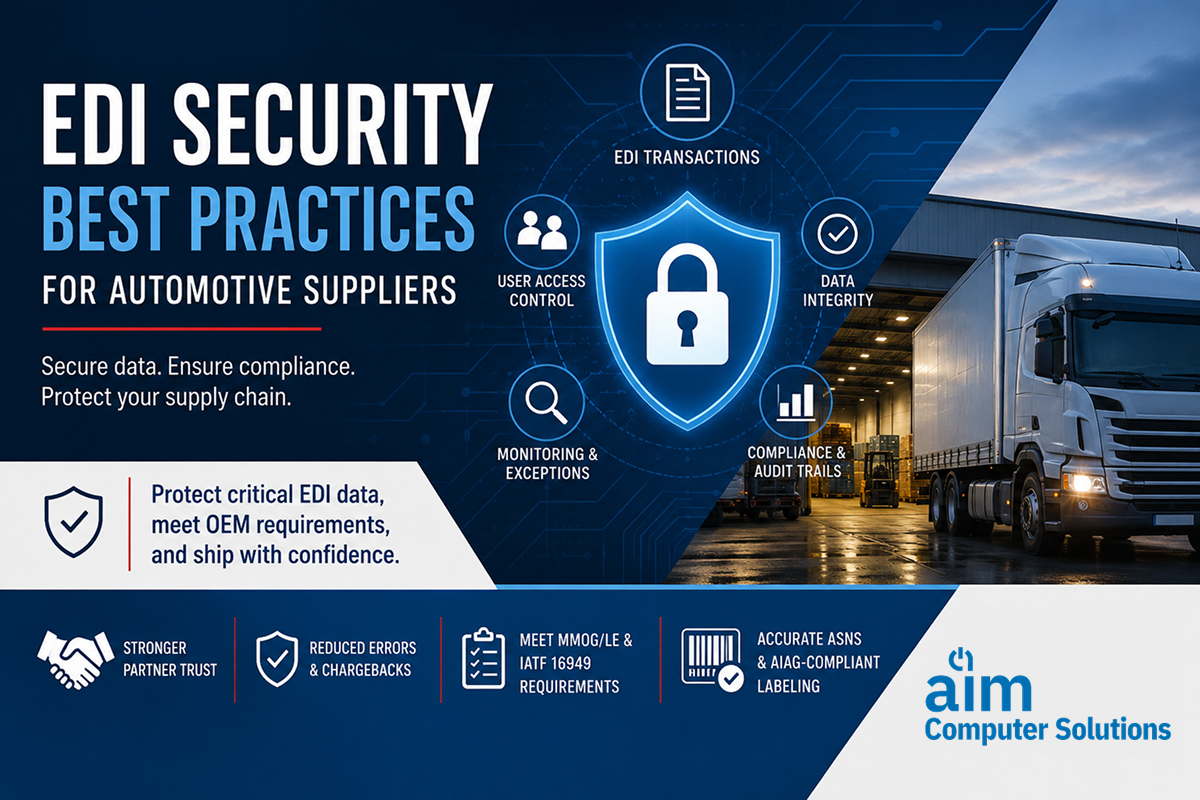
EDI Security Best Practices for Automotive Suppliers
Here’s where the rubber meets the road. Not in theory. In the shipping lane.
Start with secure EDI connectivity
Use trusted, secure methods for exchanging business documents with customers and suppliers. Whether your organization uses a VAN, direct connection, managed service, or secure communication tool, the goal is the same: protect the data in motion and reduce the chance of missed or corrupted transmissions.
But secure transport is only the first gate. Don’t stop there.
Monitor acknowledgments like they matter — because they do
A 997 confirms communication between translators. An 824 can tell you whether the ASN passed the customer’s application checks. Both matter.
Suppliers should have a process for reviewing acknowledgments quickly, especially for ASNs. Waiting until someone complains is, well, not much of a strategy.
Reduce hand-keying wherever possible
This one is huge.
EDI data should flow into order management, labeling, shipping, and ASN processes without unnecessary retyping. Barcode scanning should verify what’s physically staged or loaded. Manual ASN creation should exist only as a controlled emergency option — not a daily habit.
The goal isn’t to remove people from the process. The goal is to stop making people babysit data that the system should already know.
Validate before the truck leaves
A good system checks for the stuff that tends to bite suppliers later: missing ship-to data, invalid part numbers, wrong quantities, label mismatches, CUM discrepancies, packaging issues, and incomplete shipment details.
Once the truck leaves, your room for correction gets pretty small. Tiny, actually.
Keep customer-specific label logic current
AIAG-compliant labeling is not one-size-fits-all. OEMs and Tier customers can have very specific requirements for serial labels, master labels, mixed labels, destination labels, line-side labels, and customer-defined fields.
If your team is constantly relabeling, reformatting, or manually adjusting labels, that’s a warning sign. It may be time to look at a system that embeds customer-specific business logic instead of forcing the shipping team to remember every variation.
Protect user access
Not everyone needs the ability to change EDI data, override shipment details, or manually generate ASNs. Access should match responsibility.
This is basic security hygiene, sure, but it’s also practical shop-floor control. A well-intentioned workaround can still create a customer problem.
Build audit trails into the process
When something goes wrong, you need to know what happened. Which release came in? What changed? Who processed it? What label printed? What was scanned? What ASN went out? Was it accepted?
Without an audit trail, root-cause analysis turns into archaeology.
Have a backup plan that people actually know how to use
EDI outages happen. Network issues happen. Customer portals go sideways. Someone’s password expires at the worst possible moment, because of course it does.
A backup procedure should be documented, tested, and understood by the people who will need it under pressure. A plan hidden in a binder no one opens is not a plan. It’s office décor.
Why Automotive-Specific EDI Software Matters
Generic EDI tools move documents. Automotive suppliers need documents that are right.
That means managing release accounting, CUMs, kanban signals, standard pack rounding, ship versus delivery date logic, AIAG barcode labels, dock codes, returnable containers, and customer-specific rules that shift from one OEM or Tier customer to the next. A file that technically transmits but generates the wrong label or misreports a CUM isn’t a win. It’s a chargeback waiting to happen.
That’s where AIM focuses.
If you’re running Epicor and struggling with customer EDI, labeling changes, and ASN accuracy — AIM AutoCOR embeds automotive order management, labeling, and outbound ASN logic directly into your Epicor workflow. No custom mapping. No manual label rebuilding every time a customer changes a requirement.
If you’re managing complex OEM relationships across SAP, Oracle, or another ERP — AIM AutoSys adds the automotive EDI, release accounting, AIAG labeling, and shipping compliance layer your ERP wasn’t built to handle. It connects to 535+ trading partners and supports Ford, GM, Stellantis, Toyota, Honda, and Tier customer requirements out of the box.
If you want to keep your current ERP but need cleaner automotive EDI intelligence — AIM AutoConnect handles the CUM logic, ship codes, transit days, standard pack rules, labeling data, and outbound ASN processing, then sends clean net demand into your ERP instead of raw EDI complexity.
If you need a full ERP foundation built for repetitive automotive production — AIM Vision ERP includes EDI, barcode labeling, inventory, production, shipping, receiving, and supply chain management in one system designed specifically for automotive suppliers.
Different situations. Same result: fewer errors, cleaner compliance, and a shipping floor that doesn’t scramble at the end of every shift.
A Real-World Example: When EDI Efficiency Becomes a Competitive Advantage
Diversified Plastics Corporation is a good example of what happens when EDI becomes less of a bottleneck and more of a strength.
Using AIM AutoCOR with Epicor, DPC strengthened its automotive EDI and labeling capabilities, improved control, and reduced EDI integration time from months to days. That’s not just an IT win. That affects shipping, customer service, compliance, and the people who have to keep orders moving when demand changes again — because it always does.
There’s a quiet confidence that comes with having the process under control. You can feel it on the floor.
A Quick EDI Security Checklist
Before your next audit, customer launch, or trading partner change, ask a few uncomfortable questions:
- Are we monitoring both 997s and 824s?
- Can we prove an ASN matched the shipment?
- Are labels generated from trusted EDI and order data?
- How much data is still being manually entered?
- Do we know who can override shipment or ASN information?
- Are customer-specific requirements maintained and current?
- Can our system handle new ship-to codes or customer changes without custom chaos?
- Do we have a working backup process if EDI transmission fails?
- Are CUM discrepancies visible before they become customer issues?
If the answers are fuzzy, that’s worth paying attention to.
Secure EDI Keeps the Whole Operation Steadier
EDI security is not just about locking down files. It’s about trust.
Trust that the release is accurate.
Trust that the label belongs on that container.
Trust that the ASN reflects what actually shipped.
Trust that the customer can receive the material without chasing down corrections.
For automotive suppliers, that kind of trust is earned through systems, process discipline, and a whole lot of detail work behind the scenes.
AIM helps suppliers bring that detail work under control with automotive-specific EDI, barcode labeling, shipping, and order management solutions built for the industry’s real-world demands.
If your team is dealing with rejected ASNs, relabeling headaches, CUM confusion, or too many manual EDI workarounds, it may be time for a closer look.
Ready to strengthen your EDI security and compliance?
Talk to an AIM specialist about your specific OEM and Tier requirements — ASN validation, AIAG labeling, CUM tracking, and the EDI security gaps that tend to surface right before an audit or a new customer launch.
See how AIM handles your supply chain. Request a workflow review.