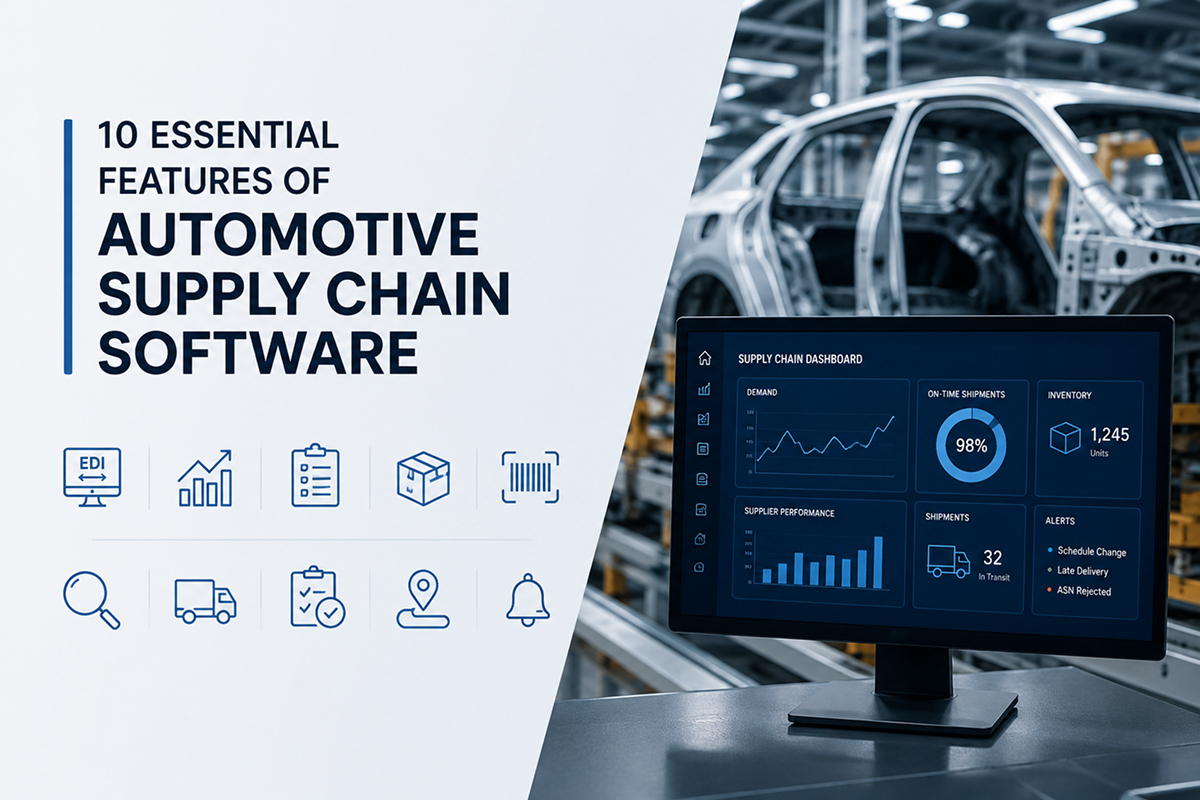
10 Essential Features of Automotive Supply Chain Software
Automotive suppliers do not have much room for error.
Customer schedules change. Material availability shifts. Production priorities move. Shipments still have to leave on time with the correct labels, quantities, and ASN data.
That is why generic business software often falls short.
Automotive suppliers need software that understands how customer demand moves through planning, production, inventory, packaging, shipping, and electronic communication.
Here are ten features that matter most.
1. Automotive EDI That Drives Action
Receiving EDI is not enough.
The system should understand automotive transactions and turn them into usable demand. It should process planning schedules, shipping schedules, purchase orders, ASNs, invoices, and acknowledgments without relying on manual re-entry.
It should also preserve release history.
That gives teams a clear view of what changed, when it changed, and how the new release affects production or shipping.
The real value of automotive EDI is not file translation. It is turning customer data into accurate operational decisions.
2. Accurate CUM Tracking
Cumulative quantities are central to automotive order management.
The system must compare what the customer says is required with what has already been shipped or received. That difference helps determine what is still owed.
When CUMs are wrong, the consequences can be serious. Suppliers may overproduce, under-ship, duplicate a shipment, or dispute quantities with the customer.
Good software should track required CUMs, shipped CUMs, received CUMs, adjustments, and reset values.
This should happen automatically. It should not depend on someone maintaining a spreadsheet.
3. Demand-Driven Planning
Customer demand should flow directly into planning.
When a release changes, the system should show the effect on production, materials, capacity, and supplier requirements. Planners should not have to rebuild the picture manually.
Automotive planning also needs to account for details that generic systems may miss, including firm and forecast periods, standard packs, transit days, lot sizes, authorizations, and phase-out parts.
The goal is simple.
Build the right quantity at the right time based on the most current customer demand.
4. Better Supplier Visibility
Outbound performance depends on inbound performance.
A supplier cannot meet an OEM schedule if a critical component is late or unavailable.
Automotive supply chain software should help teams monitor supplier releases, purchase orders, incoming shipments, acknowledgments, delivery performance, and shortages.
It should make problems visible early.
A late supplier delivery should not become obvious only after production stops. The system should give the materials team enough time to respond.
5. Real-Time Inventory and WIP Visibility
Knowing the total quantity on hand is not enough.
Teams need to know where the material is, whether it is available, and what stage it is in.
That includes raw material, purchased components, work in process, finished goods, quality-hold inventory, and staged shipments.
Barcode scanning can make this much more accurate. Material can be scanned as it is received, moved, consumed, produced, counted, or shipped.
The result is a more reliable view of the plant.
Users can quickly answer basic questions: Do we have the material? Where is it? Is it ready to use? Has it already been committed?
6. Full Traceability
Traceability should connect material, production, packaging, and shipment history.
If a quality issue occurs, the supplier should be able to identify the affected lot, the production activity tied to it, the containers involved, and the customers that received the product.
The same should work in reverse.
A customer shipment should lead back to the material and production records that created it.
This level of traceability supports audits, containment, recalls, customer complaints, and quality investigations. It also helps limit the scope of a problem.
Instead of holding everything, the supplier can focus on the material or shipments that were actually affected.
7. Automotive Labeling and Packaging Control
Automotive labeling is rarely simple.
Different customers may require different formats, serial numbers, data fields, packaging rules, and label types. Requirements can also change by plant, dock, destination, or part.
The software should support container labels, master labels, mixed-load labels, customer-specific formats, and AIAG standards.
The data should come directly from the order, inventory, packaging, and shipment records.
Manual entry creates too much risk.
The label, the physical container, and the electronic shipment record should all match.
8. Scan-Verified Shipping and ASN Automation
Shipping errors should be caught before the truck leaves.
A scan-verified process checks each container against the customer requirement. The system can confirm the part, quantity, destination, and shipment details while identifying duplicate or incorrect containers.
Once the shipment is verified, the ASN should be created from the scanned data.
That matters because the electronic shipment record should reflect what physically left the dock.
Creating an ASN from a spreadsheet or separate manual process introduces unnecessary risk.
The system should also monitor whether the ASN was accepted, rejected, or never acknowledged.
9. Customer-Specific Logistics
Automotive customers do not all follow the same rules.
One customer may require standard-pack rounding. Another may use Kanban, RANs, sequencing, or line-side delivery. Ship days, transit times, dock locations, and packaging rules may also vary.
The software must be able to manage those differences.
It should also support returnable containers such as racks, totes, and pallets. A shortage of approved packaging can delay a shipment just as easily as a shortage of parts.
Generic order management systems often treat every order the same.
Automotive software needs to understand the specific rules behind each customer, plant, destination, and program.
10. Useful Alerts and Exception Management
A good dashboard should help people act.
It should not force users to search through reports to find the problem.
The system should highlight important exceptions, including release changes, CUM mismatches, material shortages, late supplier deliveries, production delays, shipment risks, and rejected ASNs.
Different users need different views.
A materials manager may care about shortages and supplier performance. Shipping may need to see what is ready to stage. Customer service may need to review schedule changes and past-due requirements.
The best systems make urgent issues easy to find.
They show what needs attention now.
How These Features Support Compliance
MMOG/LE and IATF 16949 both depend on controlled processes, accurate records, traceability, communication, and continuous improvement.
Software does not create compliance on its own.
It does make compliance easier to maintain when validation and documentation are built into daily work.
Release history, supplier communication, traceability, label control, shipment verification, and transaction records all support a more consistent operation.
That is much stronger than relying on employees to remember separate manual checks.
What to Ask During a Software Evaluation
A software demonstration can look impressive without showing how the system handles real automotive requirements.
Ask the vendor to walk through an actual process.
How does a new customer release affect demand? How are CUMs calculated? What happens when a shipment quantity does not match the standard pack? How is the label created? How is the ASN built? What happens when the customer rejects it?
Those answers reveal whether the system was truly designed for automotive suppliers.
They also show whether the vendor understands the daily realities of production part manufacturing.
Choose Software Built for Automotive Suppliers
Automotive supply chain software should connect customer demand with what happens on the plant floor and at the shipping dock.
It should help suppliers plan accurately, control inventory, manage customer requirements, prevent shipping errors, and maintain clear records.
AIM provides automotive supply chain management software built specifically for production part suppliers.
AIM Vision connects EDI, planning, production, inventory, traceability, labeling, shipping, ASNs, and reporting within one integrated platform.
For suppliers keeping an existing ERP, AIM AutoSys, AIM AutoCOR, and AIM AutoConnect provide additional ways to add automotive EDI, order management, labeling, shipping, and customer-specific business logic.
The objective is not to add more software.
It is to create a more connected operation with fewer manual steps, fewer errors, and better control from customer release through shipment confirmation.