EDI 830 vs 862: How Planning and Shipping Schedules Work Together in Automotive Release Accounting
A new 862 lands Tuesday morning. It covers dates your 830 already scheduled. Does your team ship to the 862, the 830, or both? Here is how the two documents fit together, how CUMs connect them, and where suppliers most often get it wrong.
The short answer
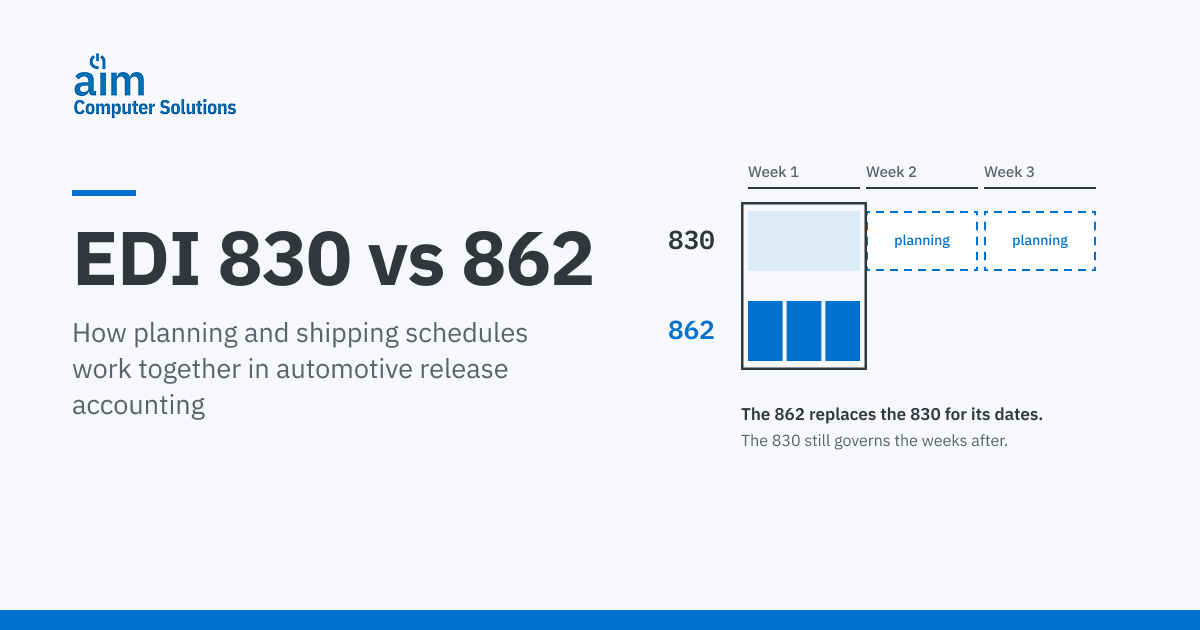
The EDI 830 is your customer's longer-range planning schedule. It drives material purchasing, capacity, and authorizations. The EDI 862 is the near-term shipping schedule. It tells you what to ship and when. Where an 862 covers dates the 830 also covers, the customer typically intends the 862 to govern those dates while the 830 still governs everything beyond. That rule is common, but not universal, so confirm it with every trading partner.
EDI 830 vs 862 at a glance
Both documents are part of the ANSI X12 standard, and both describe customer demand for the same parts. The difference is time horizon and purpose. If you're new to the standards themselves, start with our overview of EDI standards.
| Attribute | EDI 830 | EDI 862 |
|---|---|---|
| X12 name | Planning Schedule with Release Capability | Shipping Schedule |
| Primary purpose | Forecast and planning; material and capacity commitments | Near-term shipping instructions |
| Typical horizon | Weeks to months | Days to a couple of weeks |
| Typical frequency | Often weekly | Often daily, sometimes more |
| Firm vs. forecast | Mix of firm and planning quantities | Firm shipping requirements |
| Typical time buckets | Weekly or monthly, sometimes daily | Daily, sometimes by time of day |
| Drives | MRP, purchasing, capacity planning, authorizations | Shipping, dock scheduling, ASN creation |
| EDIFACT equivalent | DELFOR | DELJIT |
Frequency, horizon, and bucket size vary by trading partner. Each customer defines them in its own EDI implementation guide.
What is an EDI 830 (830 planning schedule)?
What the 830 tells you
The 830 gives your customer's projected requirements by part and ship-to location across a planning horizon. It separates firm quantities, which you're expected to ship, from planning quantities, which are forecasts that will change.
The most important thing to understand about an 830 is that it is a restatement, not a new purchase order. Each new 830 replaces the picture the previous one gave you. If your system treats every 830 as additional demand, quantities stack up quickly.
Key segments to understand
You don't need to read raw EDI every day, but knowing a handful of segments makes it much easier to diagnose problems. The example below is simplified and illustrative, not any customer's specification.
BFR*05**1042*SH*A*20261019*20270418*20261016~Beginning segment. Replaces the prior schedule (05), shipment-based (SH), discrete quantities (A), and the horizon dates.LIN**BP*12345-A~The buyer's part number.ATH*FI*20261115*12600**20260801~Fabrication authorization: the cumulative quantity you're authorized to build through a date.ATH*MT*20261213*14800**20260801~Raw-material authorization: the cumulative quantity you're authorized to buy material for.SHP*01*200*050*20261015~The customer's last receipt: quantity and date received.SHP*02*9800*051*20260801**20261015~Customer CUM received since the CUM start date. This is your reconciliation anchor.FST*1400*C*W*20261019~1,400 pieces, firm (C), weekly bucket (W), week of October 19.FST*1400*D*W*20261026~Planning quantity (D) for the following week.FST*1200*D*W*20261102~Planning quantity further out.Why fabrication and material authorizations matter
The ATH segments are easy to overlook, and they carry real financial weight. Authorizations define how much finished product you're authorized to build and how much raw material you're authorized to buy. If you buy long-lead material beyond what's authorized and the program changes, the exposure may be yours.
The terms behind authorizations are set by each customer's contract and supplier requirements manual. Know them before your purchasing team acts on planning quantities.
What the 830 should drive in your system
- MRP and purchasing, especially for long-lead material.
- Capacity and labor planning.
- Shipping, for customers who send only an 830 with firm near-term buckets and no 862.
What is an EDI 862 shipping schedule?
What the 862 tells you
The 862 gives near-term, firm shipping requirements, usually daily and sometimes with specific delivery times. It reflects the customer's latest production reality, which is why it changes so often. Where the 830 says "here is roughly what we'll need this month," the 862 says "here is what we need on these days."
Key segments
BSS*05*1043*20261020*SH*20261021*20261023~Beginning segment. Shipment-based (SH), covering October 21 through October 23 only.LIN**BP*12345-A~The buyer's part number.FST*400*C*D*20261021~400 pieces, firm, discrete date: Wednesday.FST*400*C*D*20261022~400 pieces on Thursday.FST*600*C*D*20261023~600 pieces on Friday.SHP*02*9800*051*20260801**20261019~Customer CUM received, same as on the 830.Some customers also use a JIT segment for time-of-day requirements. The horizon dates in the BSS segment matter more than they look: they tell you exactly which dates this 862 governs.
Not every customer sends an 862
Many customers ship off the 830 alone, using firm near-term buckets. Others send both. Your system needs to handle each model on a per-customer basis rather than apply one global rule to every trading partner.
How the 830 and 862 work together
This is where most release-accounting problems start. The two documents describe the same parts over overlapping dates, and your system has to decide which one to believe for each date.
Which schedule wins when they overlap
For the dates an 862 covers, the 862 typically supersedes the 830. Beyond the 862's horizon, the 830 still governs. The most common failure is adding the two together for the same dates, which double-counts demand.
Some customers define the overlap differently, which is why this has to be confirmed customer by customer rather than assumed.
"As much as the industry is striving for a common method of communicating via EDI — it is as varied as the customers we serve."
Ship dates vs. delivery dates
A shipment-based schedule tells you the date to ship. A delivery-based schedule tells you the date the customer needs the parts at its dock. For a delivery-based schedule, you have to back off the transit days to that ship-to. Skip that step, and every shipment leaves on the date it should arrive.
Turning weekly buckets into daily shipments
A weekly 830 bucket doesn't tell you which day to ship. Ship-code logic, such as "ship on Monday" or "split evenly Monday through Friday," turns a bucket into a shipping plan. Standard pack rounding then adjusts each quantity to full containers, which is also what drives your AIAG barcode labels on the way out the door.
Where CUMs connect everything
CUM (cumulative) accounting is the thread that ties the 830, the 862, and your shipments together. It works the same way regardless of which document you're shipping to.
- Discrete vs. cumulative schedules. Some customers send quantities per date. Others send a running CUM required, the total quantity they need by each date since the CUM start.
- The core calculation. Net requirement = CUM required − supplier CUM shipped.
- Reconciliation. Compare your CUM shipped with the customer's CUM received from the SHP segment. Any gap should equal shipments that are still in transit.
- Model-year CUM resets. Many customers reset CUMs at model-year changeover, on a date the customer sets. Both sides have to reset on the same date, or every calculation after it is off.
Worked example: one part, one week, both schedules
Here's how the overlap plays out for a single part. The schedule is shipment-based with discrete quantities and no transit-day offset, to keep the math clear. All numbers are illustrative.
Part 12345-A: what the 830 and 862 say for the same weeks
The 830 arrives Monday, October 19. The 862 arrives Tuesday, October 20, and covers Wednesday through Friday.
Adding both schedules
830 firm 1,400 + 862 total 1,4002,800 pieces
Double the real requirement. The extra 1,400 pieces become inventory nobody ordered, and the error repeats with every new release.
862 replaces the 830 for its dates
400 Wed + 400 Thu + 600 Fri1,400 pieces
Ship to the 862 for October 21–23. The 830's planning buckets still drive the weeks after.
Same answer from a cumulative schedule
If this customer sent cumulative quantities instead, the 862 would state a CUM required of 11,400 by Friday. With a supplier CUM shipped of 10,000, the net requirement is 11,400 − 10,000 = 1,400 pieces. The math lands in the same place, which is exactly why CUM accuracy matters: if your CUM shipped is wrong, every net requirement after it is wrong too.
Checking the CUMs
Before you trust that net requirement, reconcile your CUM shipped against the customer's CUM received from the SHP segment.
| CUM reconciliation, Part 12345-A | Reconciles | Doesn't reconcile |
|---|---|---|
| Supplier CUM shipped | 10,000 | 10,000 |
| Less: shipped Oct 19, still in transit | − 200 | − 200 |
| Expected customer CUM received | 9,800 | 9,800 |
| Customer CUM received (SHP segment) | 9,800 | 9,600 |
| Unexplained difference | 0 | 200 |
In the second case, 200 pieces are unaccounted for. The cause could be a missed receipt on the customer side, a duplicated or incorrect advance ship notice (ASN), or a shipment recorded twice on yours. Whatever the cause, investigate it now. Unresolved CUM gaps don't fix themselves, and they get harder to trace with every release.
EDI 866: when sequence matters
The X12 866 (Production Sequence) tells you the order in which parts must arrive to match the customer's build sequence. It's used in sequenced delivery and in-line vehicle sequencing (ILVS) programs.
Think of the three documents as layers. The 830 handles planning, the 862 handles daily quantities, and the 866 handles the order and timing of individual parts or sets. Sequencing raises the stakes because a sequence error shows up immediately on the customer's line, so internal sequencing, labeling, and shipping have to stay tightly aligned.
DELFOR vs DELJIT: the EDIFACT equivalents
Customers outside North America, and some global Tier 1s, use the UN/EDIFACT standard instead of X12. The concepts map closely.
| X12 document | EDIFACT message | Purpose |
|---|---|---|
| 830 Planning Schedule | DELFOR (Delivery Schedule) | Longer-range planning and forecast requirements |
| 862 Shipping Schedule | DELJIT (Delivery Just In Time) | Near-term, firm shipping requirements |
| 866 Production Sequence | DELJIT, in some implementations | Sequenced call-offs, depending on the customer |
Suppliers that ship to both North American and European or global customers often receive both standards. The overlap rules and CUM logic still apply; the segment structures are different, so your system has to interpret each correctly.
Five common 830/862 mistakes
- Double-counting overlapping schedules. Adding the 830 and 862 for the same dates leads to overproduction and inventory you didn't need.
- Treating each release as a new order. Releases are restatements. Stacking them inflates demand and sends the wrong signal to MRP and purchasing.
- Ignoring CUM discrepancies. Small gaps left until quarter-end or model-year changeover compound into shipment disputes that are hard to trace.
- Shipping to delivery dates. On a delivery-based schedule, skipping the transit-day offset means every shipment arrives late.
- Re-keying releases manually. Typing releases into an ERP that wasn't built for release accounting is where typos, missed changes, and lag creep in.
Questions to confirm with every customer
Most of the mistakes above trace back to an assumption about how a customer uses its schedules. These questions close the gap. Ask them during onboarding, and again whenever a customer changes its EDI version or launches a new program.
Want this as a fill-in worksheet for each trading partner? Download the Customer Release-Behavior Worksheet.
What your system should do with 830s and 862s
Whatever software you use, these are the capabilities that keep release accounting accurate:
- Process inbound 830s and 862s automatically, without manual re-keying.
- Apply customer-specific overlap rules instead of one global rule.
- Map firm and forecast requirements separately.
- Track CUM required, CUM shipped, and CUM received to calculate net quantities.
- Apply ship-code logic, transit days, and standard pack rounding.
- Keep release history so planners can compare what changed from one release to the next.
Generic ERP systems often handle orders well but weren't designed around automotive release accounting. That's the gap AIM's automotive EDI software was built to close.
How AIM handles release accounting
The right AIM solution depends on your ERP and on which system you want to own day-to-day execution.
You want to keep your current ERP. AIM applies CUM logic, ship codes, transit days, and standard pack rules, then passes clean net demand to your ERP, which keeps managing shipping, labels, and inventory. AIM sends the outbound ASN.
You run SAP, Infor, Dynamics, or another ERP and want deeper AIM-managed EDI, release accounting, labeling, shipping, and ASN control, including multi-plant EDI and 866 sequencing.
You run Epicor ERP or Epicor Kinetic. Epicor stays your system of record while AIM processes customer EDI into Epicor Demand Management, with accum quantity management and standard pack rounding applied.
You're replacing your ERP. AIM Vision processes 830/DELFOR and 862/DELJIT requirements through release order accounting and keeps release history, so you can see net changes between releases.
Not sure your net requirements are right?
Send us one customer's 830 and 862. An AIM specialist will walk through how your net requirement should be calculated, how the two schedules overlap for that customer, and where your current process could be introducing errors.
It's a workflow review, not a product pitch.
Frequently asked questions
What is the difference between EDI 830 and 862?
The EDI 830 is a planning schedule that gives forecast and firm requirements over weeks or months. It drives material, capacity, and authorizations. The EDI 862 is a shipping schedule that gives firm, near-term requirements, usually daily. It tells you exactly what to ship and when.
Does the 862 replace the 830?
Only for the dates the 862 covers, and only when that's how the customer defines it. Beyond the 862's horizon, the 830 still governs. Confirm the overlap rule with each trading partner rather than assuming it.
What is an 830 planning schedule used for?
Suppliers use the 830 to plan material purchases, capacity, and labor. It also carries fabrication and raw-material authorizations. For customers who don't send an 862, its firm buckets drive shipping too.
What is an EDI 862 shipping schedule?
The 862 is the X12 Shipping Schedule. It gives firm, near-term shipping requirements, often by day and sometimes by time of day, and it supersedes the 830 for the dates it covers when the customer uses it that way.
Do all automotive customers send an 862?
No. Many customers send only an 830 with firm near-term buckets. Others send both an 830 and an 862. Your system needs to support both models, customer by customer.
What is EDI 866?
The EDI 866 is the X12 Production Sequence. It tells a supplier the order in which parts must arrive to match the customer's build sequence, and it's used in sequenced or in-line vehicle sequencing programs.
What is the difference between DELFOR and DELJIT?
DELFOR and DELJIT are UN/EDIFACT messages. DELFOR (Delivery Schedule) generally corresponds to the X12 830 and carries planning requirements. DELJIT (Delivery Just In Time) generally corresponds to the 862 and carries firm near-term requirements; some customers also use it for sequenced call-offs.
What is a CUM in automotive EDI?
A CUM is a cumulative quantity counted from a start date, often the model year. Suppliers track CUM required, CUM shipped, and the customer's CUM received. The net requirement is CUM required minus CUM shipped, and CUM shipped should reconcile with CUM received after accounting for shipments in transit.
EDI segment examples and quantities in this article are simplified illustrations, not any customer's implementation guide. Always follow your trading partner's published EDI specifications and supplier requirements.