EDI 810 and 820: How Automotive Suppliers Get Paid
Last updated November 2026
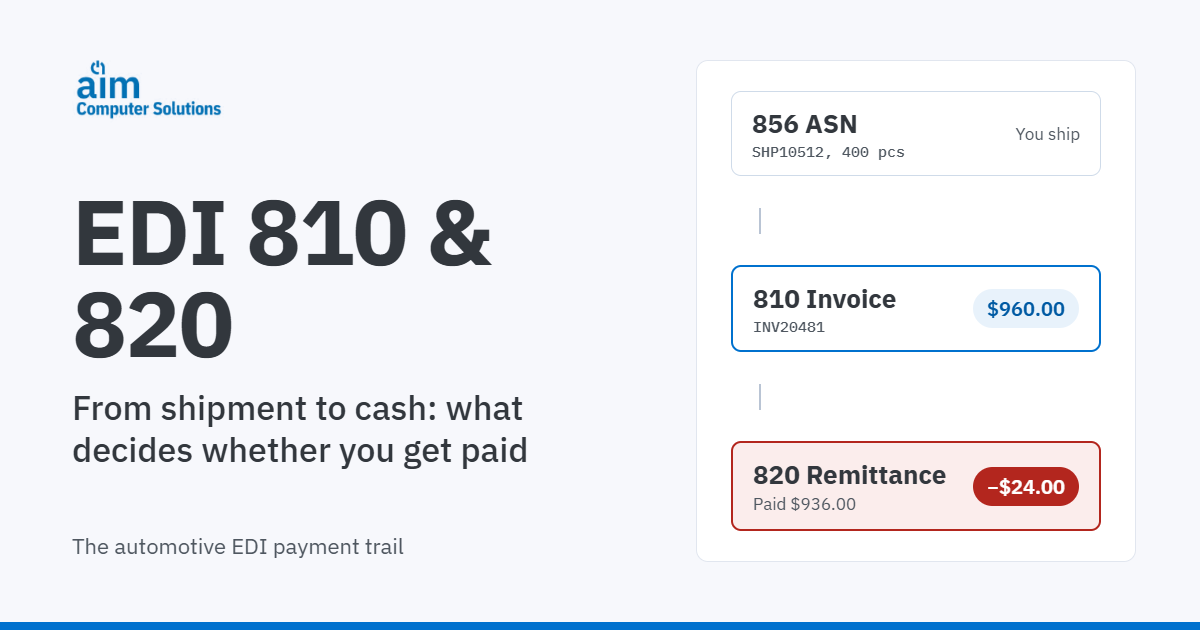
The truck left on time. The ASN went out, the invoice followed, and the customer acknowledged both. Weeks later, the payment came in $24 short, with an adjustment code and no other explanation. Now shipping, EDI, and finance are on the same email thread, and each team can see only its own piece of the problem.
In automotive, getting paid depends on a chain of documents that all have to agree: the 856 advance ship notice, the customer’s receipt (sent as an 861 where the customer uses one), the 810 invoice, and the 820 remittance. An 824 can come back at several points to say something was rejected. And for many production programs, the invoice isn’t even the document that triggers payment.
This guide follows that chain from shipment to cash, shows where it breaks, and walks through how to trace a short payment back to its source.
Key takeaways
- Start by knowing how each customer pays. Some pay from your 810. Others pay from your ASN and their own receipt, so the ASN is the invoice in practice.
- Most payment problems start upstream, in shipment data, CUMs, or price, and show up in AR weeks later.
- The 820 is often where a mismatch finally becomes visible. Every adjustment on it should be traceable to a specific shipment.
- Generating the ASN, labels, and invoice from the same shipment data, with price kept in one place, closes most of the gaps.
First question: how does this customer pay you?
Most EDI invoicing advice assumes the supplier sends an invoice, the customer matches it against the purchase order and the receipt, and payment follows. That’s one model. Automotive customers use at least three, and the model decides which document your cash depends on.
Invoice-based settlement
Payment trigger: your 810
You send an 810 after shipment. The customer checks it against your ASN, its receipt, and the agreed price, then pays. A bad invoice is held or rejected.
Pay on receipt (ERS)
Payment trigger: your ASN plus their receipt
Under evaluated receipt settlement, the customer pays from what it received and the agreed price. No invoice is sent. Adient’s published supplier manual, for example, states that for ERS-approved suppliers the ASN serves as the electronic invoice.
Self-billing
Payment trigger: the customer’s own invoice
Common with European OEMs using EDIFACT or VDA formats. The customer creates the invoice from its receipt and pricing and sends it to you. It can look like a credit note even though it’s your invoice.
The same customer can use different models for production parts, service parts, and component sales. So the question isn’t “does this OEM use ERS?” It’s “which model applies to this program and ship-to?”
Why this matters
If a program pays on receipt, your ASN isn’t just shipping paperwork. Its accuracy is your invoice accuracy. A quantity error on the ASN becomes a payment error with no invoice step to catch it. The customer’s current guideline governs, so confirm the settlement model for each trading partner and program.
The payment trail: from release to remittance
Here’s how the documents connect in the two most common North American models. The highlighted document is the one your payment is calculated from.
Invoice-based settlement
- 830 / 862Releases
- 856ASN at shipment
- 861Receipt, where used
- 810Invoice
- 820Remittance
Pay on receipt (ERS)
- 830 / 862Releases
- 856ASN acts as the invoice
- 861Receipt and discrepancies
- 820Remittance
In EDIFACT programs, the comparable messages are DESADV (ASN), RECADV (receiving advice), APERAK (application advice), INVOIC (invoice), and REMADV (remittance advice). For more on how the standards line up, see EDI standards explained.
What the 810 carries and what it’s checked against
The 810 is the supplier’s electronic invoice. In automotive it usually carries:
- Invoice number and date
- Shipment references: the shipper or packing slip number, and often the ASN or bill of lading
- The customer’s purchase order, usually a blanket PO, plus release references where the customer requires them
- Customer part numbers, quantities, and unit prices
- Charges such as expendable containers, plus taxes and terms
The automotive twist is where price comes from. Retail invoicing matches against a one-time 850. Automotive invoices are usually checked against the price on a blanket PO, while releases set the quantities. If a price change on that blanket order never reaches your billing system, every invoice that follows is wrong. Our EDI 850 in automotive post walks through exactly that scenario.
Two structural rules also catch suppliers out:
- Shipper-to-invoice linkage. Many customers expect one invoice per shipper. Combining several packing slips on one invoice, or splitting one shipment across invoices, can stop the match.
- Timing and sequence. Some customers set invoice windows. One Tier 1 guideline, for example, requires the 810 within 48 hours of shipment. Others reject an invoice that arrives before its ASN.
The mismatch map: where invoices and payments go wrong
Each failure below starts in a different part of the business, which is why invoice problems are hard to solve from AR alone.
| Failure type | Where it usually starts | How it shows up |
|---|---|---|
| Quantity | Short ship, over-ship, or an ASN that doesn’t match the truck | 861 discrepancy, then a quantity deduction on the 820 |
| Price | Price kept in more than one place, or a missed price change | 824 rejection or a price adjustment on the 820 |
| Reference | Wrong or missing PO, release, or shipper number | Invoice can’t be matched and sits on hold |
| Shipper-to-invoice break | Packing slips combined on one invoice | Rejection or hold |
| CUM variance | Supplier and customer cumulative counts drift apart | Disputed quantities, debit memos, payment delays |
| Quality or returned material | Defective, scrapped, or returned parts | Debit lines on the 820 tied to material, not price |
| Container charges | Expendable container costs not captured at shipment | Charge missing from the invoice, or not recognized |
| Retro pricing | Price change applied after parts already shipped | Retro billing, credit memos, adjustments on later payments |
| Timing or sequence | Invoice sent before the ASN, or outside the window | Rejection, or held until the receipt posts |
| Duplicate invoice | Resending a corrected invoice under the same number | Rejection, or a second payable the customer later reverses |
The 856 and 861: where the receipt gets decided
The 856 is your claim about what shipped. The 861 Receiving Advice is the customer’s record of what arrived. When the two disagree, the customer’s receipt usually wins at payment time.
Customers that send 861s typically use them to report:
- Shortages or overages against the ASN quantity
- Material received with no matching ASN
- Damaged or rejected material
- Returns and authorized scrap
The 861 also connects payment to CUM. Some customers’ 861 specifications, including Ford’s, distinguish between a discrepancy that adjusts the customer’s CUM and one that doesn’t. If the customer adjusts its CUM and you don’t, the next release nets against a different number than yours. You see it as a schedule problem and as a payment problem at the same time. Our 830 vs. 862 post explains how CUMs drive net requirements.
In a pay-on-receipt program, this is the whole story. An inaccurate ASN or an unresolved receiving discrepancy is an inaccurate payment.
Most of these discrepancies start before the truck leaves: a label that doesn’t match the ASN, a pallet loaded without being scanned, or an ASN edited by hand after shipment. That’s why ASN accuracy and AIAG label accuracy are finance issues, not just shipping issues.
The 824 and 997: rejection signals that are also payment signals
A 997 tells you the customer’s system received your file. It doesn’t tell you the content was accepted. The 824 Application Advice is what reports a content problem. We cover the difference in detail in EDI 997 vs. 824.
For payment, the key question is which document the 824 rejected. Customers use it differently:
- Some send 824s only against ASNs.
- Some send them against invoices, for problems like an unrecognized price or reference.
- Some send both.
In a pay-on-receipt program, an 824 rejecting your ASN is effectively a rejected invoice. Payment for that shipment can stall until the ASN problem is resolved the way the customer’s guideline requires.
That makes 824 handling a cash question. An 824 sitting unread in a shared EDI mailbox is a payment delay that nobody has noticed yet. Route each one to the team that can fix it, on the day it arrives.
The 820: reading the remittance
The 820 Payment Order/Remittance Advice is where the story ends. Its EDIFACT counterpart is REMADV. It tells you what the customer paid and how to apply it, and it’s often the first place an upstream mismatch becomes visible.
Depending on the customer, an 820 can show:
- The payment amount, method, and date
- Which invoices or receipts the payment covers, often many at once
- The amount paid against each one
- Adjustments with reason codes: price differences, quantity shortages, quality debits, container charges, and other deductions
Here’s a simplified 820 paying the invoice from the opening scenario:
Two cautions apply when you build cash application around the 820:
- Not every customer sends one. Some send 820s only on request. Others pay by EFT with remittance on a portal, or with no electronic remittance at all.
- Remittance isn’t settlement. An 820 tells you how a payment is meant to be applied. Confirming the funds arrived still comes from your bank.
Tracing a short-pay backward: a walkthrough
When an 820 adjustment arrives, the fastest way to resolve it is to walk the chain backward until the documents stop agreeing. Here’s the opening scenario, using part 12345-A and blanket PO 4500012 from our earlier posts. All values are illustrative.
Start with the 820
Invoice INV20481 was paid $936.00 of $960.00. The adjustment is −$24.00 with a price-related reason code.
Symptom: $24.00 shortOpen the 810
The invoice billed 400 pieces of 12345-A at $2.40, for shipper SHP10512, shipped November 18.
Invoice: 400 × $2.40 = $960.00Pull the 856 for shipper SHP10512
The ASN shows 400 pieces on two pallets of 200, with the same PO and part references as the invoice.
ASN matches the invoiceCheck the receipt and the 861
The customer received 400 pieces with no discrepancy and no CUM adjustment. Scan records confirm both pallets were loaded.
Quantity is not the problemCheck the price source
An 860 on blanket PO 4500012 changed the price to $2.34 for shipments after November 16. It was never applied to the billing price. The difference is 400 × $0.06 = $24.00.
Root cause: missed price changeFix it forward
Correct the price at its source, resolve the difference through the customer’s credit or retro process, and check every invoice shipped after November 16 for the same error.
This trace is quick when the ASN, labels, invoice, and price all come from the same system. It’s slow when they live in separate systems, spreadsheets, and inboxes, and every step means asking another team for a document.
Why finance can’t see the root cause
Each document in the chain usually belongs to a different team, while the consequence lands in one place:
| Document | Usually owned by | Who feels a problem |
|---|---|---|
| 830 / 862 releases and CUM | Materials or customer service | Shipping, then AR |
| Blanket PO price and 860 changes | Sales or customer service | AR |
| Labels and 856 ASN | Shipping | Customer receiving, then AR |
| 997 and 824 | IT or the EDI coordinator | Whoever finds them, often late |
| 861 receiving advice | Often nobody | Materials and AR |
| 810 invoice and 820 remittance | AR | AR and the controller |
The cause sits upstream and the symptom shows up weeks later in AR. A few things widen the gap: rekeying data between systems, maintaining price in more than one place, having no check before the ASN goes out, and sending 824s and 861s to a shared mailbox nobody owns.
A checklist for cleaner shipment-to-cash
- Document the settlement model for each customer, program, and ship-to.
- Keep price in one source of truth.
- Apply price changes and retro adjustments deliberately, with a record of each one.
- Keep shipper-to-invoice linkage clean where the customer requires it.
- Generate the ASN, labels, and invoice from the same shipment data.
- Scan-verify what’s loaded before the ASN goes out.
- Route every 824 and 861 to a named owner the day it arrives.
- Reconcile customer and supplier CUMs before variances become disputes.
- Capture expendable container charges at shipment.
- Match every 820 adjustment to a shipment, and investigate the ones you can’t explain.
Who sends what: examples from AIM implementations
AIM has implemented these transaction sets for suppliers shipping to a wide range of OEM and Tier customers. Requirements vary by customer and program, and trading partners update their specifications over time, so every implementation starts with the customer’s current guideline.
| Transaction set | X12 examples | EDIFACT examples |
|---|---|---|
| 810 Invoice | Toyota (TMM and TMS), Honda, Stellantis (FCA), Tesla, Rivian, Caterpillar, John Deere | INVOIC: BMW, Cummins, GM (SPO), ZF |
| 820 Remittance Advice | Toyota (TMM and TMS), Honda, Stellantis (FCA), Ford (CMMS3), Hyundai, Kia, Mazda, Nissan, Rivian, Subaru of Indiana | REMADV: BMW |
| 824 Application Advice | Toyota (TMM and TMS), Honda, Stellantis (FCA), Tesla, Ford (CMMS3 and Ship Direct), Eaton, Dana | APERAK: GM Standard EDIFACT, Delphi/APTIV, Lucid |
| 861 Receiving Advice | Toyota (TMM and TMS), Honda, Stellantis (FCA), Ford (CMMS3), Hyundai, Kia, Nissan Mexico | RECADV: GM Standard EDIFACT, American Axle, Cummins, Delphi/APTIV |
The full chain
For Toyota, Honda, and Stellantis, AIM has implemented the 810, 820, 824, and 861 together, covering the full path from invoice to remittance.
How AIM keeps shipment, invoice, and price data aligned
AIM builds automotive EDI, order management, labeling, and shipping for production part suppliers. AIM’s EDI tools support common financial transactions, including 810 invoices and 820 remittance advice. AIM supports customer-specific EDI, labeling, ASN, CUM, and invoicing requirements where a program is supported. Which product fits depends on your ERP.
AIM AutoCOR
For suppliers running Epicor ERP or Epicor Kinetic
- Enforces 1:1 shipper-to-invoice linkage: each AutoCOR shipper creates its own Epicor invoice, with Combine Packing Slips turned off.
- Retrieves the current Epicor selling price before generating any electronic 810. Epicor stays the system of record.
AIM AutoSys
For suppliers keeping SAP, Oracle, Infor, Dynamics, or another ERP
- Alerts for Selling Price Changes, and a Retro Billing Utility that calculates adjustments and generates invoices and credit memos.
- Captures expendable container costs for customer billing.
- Tracks CUM required, supplier CUM shipped, and customer CUM received, with scan verification through AIM Mobility.
AIM Vision ERP
For suppliers replacing their ERP
- Generates labels and ASNs from the same source data, and validates ASN data against customer requirements before transmission.
- Reconciles customer CUM requirements with supplier CUM shipped and received, helping prevent disputes that result in debit memos or payment delays.
AIM AutoConnect
For suppliers keeping their ERP for shipping execution
- An automotive EDI integration layer: AIM handles EDI interpretation, net demand, CUM logic, and ASN transmission.
- Your ERP keeps normal operational execution. Useful where pay-on-receipt programs make ASN accuracy the priority.
Three questions to ask your team
- Do you know which of your customers pay from your ASN rather than your invoice?
- When an 820 comes in short, can you trace the adjustment to a specific shipment in minutes?
- Is any part price maintained in more than one place?
FAQ
Is an ASN the same as an invoice?
Not by definition. The 856 ASN describes a shipment, and the 810 bills for it. But in pay-on-receipt (ERS) programs, the customer pays from the ASN and its own receipt with no invoice, so the ASN functions as the invoice. Check each customer’s guideline.
What’s the difference between an 810 and an 820?
The 810 is the supplier’s invoice, sent to the customer. The 820 is the customer’s payment order or remittance advice, sent to the supplier. It explains what was paid, against which invoices or receipts, and with what adjustments.
Does every automotive customer send an 820?
No. Some send 820s routinely, some only on request, and some pay by EFT with remittance details on a portal or none at all. The customer’s guideline tells you what to expect.
What does an 861 tell a supplier?
The 861 Receiving Advice reports what the customer actually received against your ASN, including shortages, overages, damaged or rejected material, and returns. Some customers also use it to indicate whether a discrepancy adjusts their CUM.
Can an 824 reject an invoice?
Yes, for customers that use it that way. Some customers send 824s only against ASNs, some against invoices, and some against both. In pay-on-receipt programs, an 824 rejecting the ASN can hold up payment even though no invoice is involved.
What is evaluated receipt settlement?
Evaluated receipt settlement (ERS), also called pay on receipt, is a model where the customer pays from its record of goods received and the agreed price, without a supplier invoice. In automotive, the supplier’s ASN is the key input.
See how your shipment, invoice, and price data stay aligned
In a 20-minute walkthrough, we’ll show how the AIM product that fits your ERP connects ASNs, labels, CUMs, and invoices for your most demanding customers.
Schedule a walkthroughTrading partner requirements change. Examples in this article are illustrative or drawn from published supplier documentation and AIM’s 2026 Product Catalog. Always work from your customer’s current guideline.