How Automotive Suppliers Can Reduce Supply Chain Delays
Automotive suppliers don’t have much room for delay.
When a shipment misses its window, the problem is rarely isolated. Production schedules shift. Customer portals flag exceptions. Shipping teams scramble to confirm labels, ASNs, quantities, and paperwork. Materials teams retrace EDI releases and CUMs to figure out where the requirement changed.
Sometimes the cause is outside your control: carrier delays, supplier shortages, weather, labor constraints, or sudden demand changes.
But many supply chain delays start inside the process.
A late EDI update. A CUM mismatch. An ASN with missing or incorrect data. A barcode label that no longer matches the customer’s requirement. Inventory that appears available in the system but cannot be found, scanned, or shipped when it matters.
For automotive production part suppliers, these issues create real risk. The part may be built. The order may be staged. The truck may even be waiting at the dock. But if the data, labels, quantities, or shipment documents are wrong, the shipment is still at risk.
Mitigating supply chain delays isn’t only a logistics problem — it’s an order management, EDI, inventory, labeling, and shipping control problem.
Why Supply Chain Delays Hit Automotive Suppliers So Hard
Automotive doesn’t leave much breathing room.
OEMs and Tier customers are running tight schedules, tight delivery windows, tight tolerances, and tighter-than-anyone-wants scorecards. A delay that might be inconvenient in another industry can become a production headache in automotive. Sometimes a very expensive one.
One missed shipment can ripple into premium freight, customer complaints, supplier rating damage, and the dreaded “why did this happen?” meeting that nobody enjoys.
And here’s the rub: the supply chain is not just trucks and pallets. It’s also EDI, ASNs, labels, CUMs, releases, dock codes, standard packs, inventory records, and customer-specific rules that seem to multiply when nobody is looking.
So when automotive suppliers talk about how to mitigate supply chain delays, they shouldn’t only talk about transportation. They need to talk about order-to-ship control.
The Sneaky Causes of Supply Chain Delays
Some delays announce themselves with a bang. A machine goes down. A supplier misses a delivery. A snowstorm turns a normal lane into a parking lot.
Others? They creep in wearing soft shoes.
A customer sends a new 862 shipping schedule, but the update doesn’t flow cleanly into the planning process. Someone exports a spreadsheet, makes a manual adjustment, and hopes everyone else is working from the same version. By Friday afternoon, nobody’s completely sure which number is right.
That’s how trouble gets in.
EDI data is supposed to keep the supply chain moving, but when releases, forecasts, and shipping schedules are handled manually—or stitched together with workarounds—the risk grows fast. Automotive suppliers need to process changing customer requirements without forcing materials, production, and shipping teams to become part-time detectives.
CUM tracking is another troublemaker. If the customer’s CUM required, supplier CUM shipped, and customer CUM received don’t line up, the team may think they’re on schedule when they’re actually short. Or they may expedite product that didn’t need to move yet. Either way, it’s a mess.
Inventory accuracy is no small thing either. Saying “we have it” is not the same as knowing where it is, whether it’s available, whether it’s the right revision, or whether it’s already staged for another order. That gap can turn into real supply chain shipping delays at the worst possible moment.
Unforeseen Delays vs. Preventable Delays
Let’s be fair. You can’t automate away a closed border, a flooded highway, or a supplier’s resin shortage.
There will always be unforeseen delays in supply chain management. That’s just the business. Anyone who says they can prevent every disruption is selling fairy dust.
But a lot of delay-related pain gets worse because the supplier doesn’t see the problem early enough. The team finds out when the shipment is already late, the ASN has already failed, or the customer has already called.
That’s the difference between a disruption and a scramble.
A disruption says, “We have a problem.” A scramble says, “We didn’t know we had a problem until it was already chewing through the schedule.”
The goal isn’t perfection. It’s readiness. It’s having enough visibility and control that when something does go sideways, your team isn’t starting from zero.
Better EDI Is a Delay-Fighting Tool
EDI isn’t glamorous. Nobody puts “clean 830 processing” on a motivational poster.
Still, it matters. A lot.
Customer releases and shipping schedules are the starting gun for production and shipping decisions. If that information is late, misread, manually rekeyed, or trapped in a disconnected system, everything downstream gets wobbly.
Automated EDI processing helps suppliers receive and interpret customer requirements faster. More importantly, it helps remove the guesswork.
For automotive suppliers, that means supporting the real-world alphabet soup: 830s, 862s, 856 ASNs, 810 invoices, 824 application advice, and more. It also means handling the customer-specific logic that comes with OEM and Tier relationships.
Because EDI is not just “moving files.” Not in automotive.
It’s understanding what those files mean, how they affect net demand, what needs to show up on the label, when the shipment should leave, and what the ASN must include so it doesn’t bounce back like a bad check.
CUM Tracking: Boring Until It Isn’t
CUM accounting is one of those automotive things that sounds painfully dry—until it causes a shipment dispute.
Then everyone cares.
Cumulative tracking helps suppliers understand what the customer has required, what the supplier has shipped, and what the customer has received. When those numbers fall out of sync, the supplier can end up over-shipping, under-shipping, or arguing over past-due quantities that may or may not be real.
Good times.
To mitigate supply chain delays, suppliers need CUM tracking tied into release accounting, shipping history, and customer demand. Not a spreadsheet floating around on someone’s desktop. Not a manual tally that only one person understands. A real process.
This is where AIM’s automotive-specific approach matters. AIM AutoSys, AIM AutoCOR, and AIM Vision are built around the actual way automotive suppliers manage releases, CUMs, ASNs, labels, and shipping requirements—not a generic order process dressed up for manufacturing.
Inventory Visibility Keeps Small Problems from Becoming Big Ones
There’s a special kind of frustration in thinking material is available and then finding out it isn’t.
Maybe it’s in the wrong warehouse. Maybe it’s tied up in WIP. Maybe it was counted wrong. Maybe it’s there, technically, but buried behind three racks and a forklift battery charger. You know how it goes.
Real-time inventory visibility gives planning and shipping teams a fighting chance.
When inventory transactions are captured as they happen, suppliers can make better decisions about production schedules, customer shipments, and shortage risks. They can see material movement. They can trace lots. They can respond before the schedule starts to unravel.
AIM Vision supports this kind of control by connecting inventory, production, shipping, receiving, and traceability into a system built for automotive production part suppliers. That matters because inventory accuracy is not just an accounting issue. It’s an on-time delivery issue.
And, frankly, it’s a sanity issue too.
Shipping Delays Often Start Before the Truck Arrives
When people hear supply chain shipping delays, they usually picture the truck being late.
Sometimes that’s true. But in automotive, shipments can be delayed before a carrier ever backs into the dock.
The labels aren’t right. The ASN isn’t ready. The paperwork is missing. The quantity doesn’t match the shipper. The standard pack logic is off. Someone has to relabel. Someone has to reprint. Someone has to call IT.
Meanwhile, the clock is tapping its foot.
Dock-level validation helps stop those issues before the shipment leaves. Barcode scanning, shipment verification, AIAG-compliant labeling, and ASN checks all act like a final gate. Not a bureaucratic gate. A useful one.
AIM Mobility apps extend this control to the shop floor and shipping dock, helping teams scan, verify, label, and ship with more confidence. AIM AutoSys adds shipping visibility, alerts, labeling support, and ASN validation so suppliers can catch issues while there’s still time to fix them.
It’s a lot easier to correct a shipment on the dock than after it’s already been rejected.
Alerts Are Not Noise When They’re Done Right
Everyone has too many notifications. Nobody needs another blinking light just for the sake of blinking.
But the right alert, at the right moment? That’s gold.
A supplier should know when inventory goes negative, when demand looks unusual, when a shipment deadline is approaching, when an engineering change needs attention, or when EDI data fails to process correctly.
That’s how teams move from reactive to proactive.
Instead of discovering a delay after it has already hit the customer, they can see risk forming upstream. Like storm clouds. Not always avoidable, but at least visible.
AIM AutoSys includes alerts and notifications designed around automotive supplier workflows, helping teams address exceptions before they become customer-facing problems.
A Practical Way to Mitigate Supply Chain Delays
There’s no magic trick here. No silver bullet hiding in the warehouse.
To mitigate supply chain delays, automotive suppliers need a more controlled order-to-ship process. It sounds simple, but the details matter.
Ask a few uncomfortable questions:
- Can customer releases flow into planning without manual rekeying?
- Are CUMs reconciled in the system, or is someone nursing a spreadsheet like it’s a houseplant?
- Can shipping verify labels, quantities, and containers before the truck leaves?
- Does inventory reflect what’s actually happening on the floor?
- Are ASNs checked before they go out?
- Can the team see at-risk shipments early enough to do something useful?
If the answer is “sort of” or “depends who’s working that day,” there’s probably room to tighten the process.
How AIM Helps Suppliers Stay Ahead of Delays
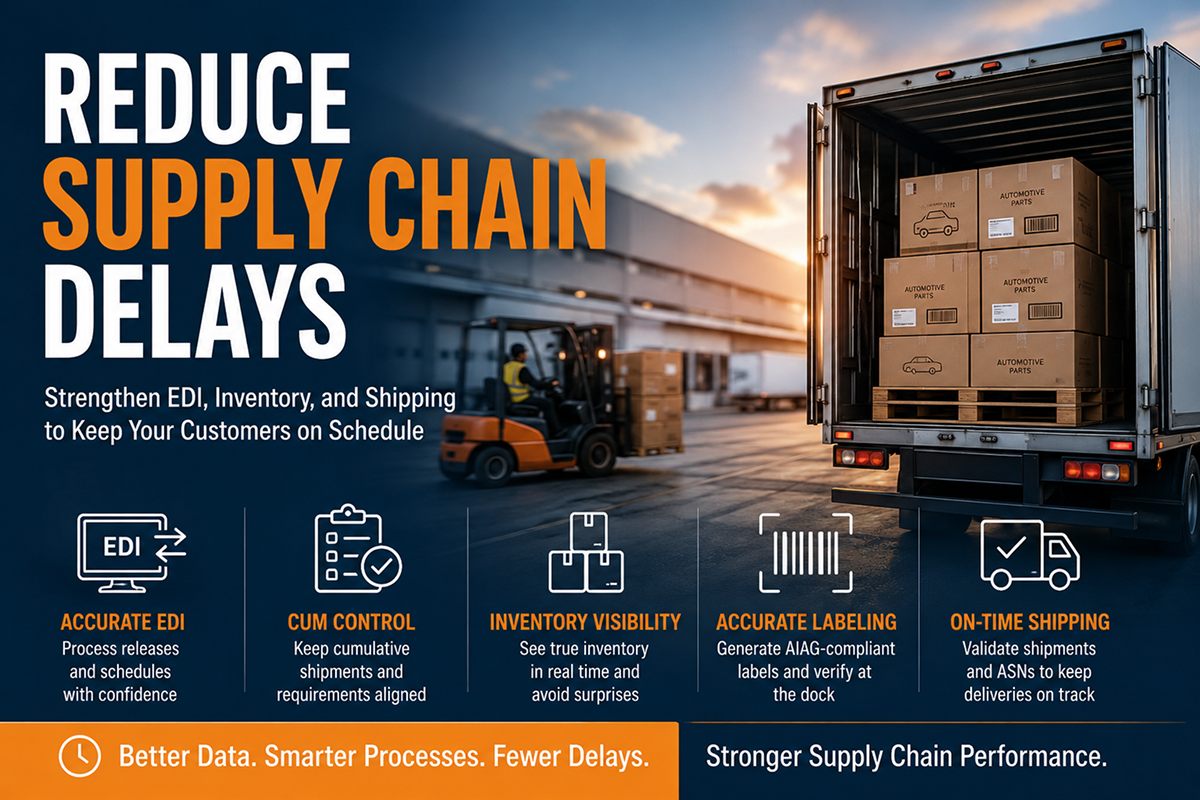
AIM eliminates the process gaps that cause avoidable delays and ties together what too many suppliers manage in disconnected systems: EDI, CUM tracking, inventory, barcode labeling, shipping validation, ASNs, and compliance workflows.
AIM Vision ERP gives suppliers a full automotive ERP foundation for managing EDI, inventory, production, shipping, traceability, and financial integration.
AIM AutoSys gives suppliers advanced automotive EDI, order management, AIAG-compliant labeling, CUM tracking, shipping control, and ASN validation without forcing a full ERP replacement.
AIM AutoCOR helps Epicor users manage automotive EDI, releases, labels, ASNs, and shipping requirements with embedded OEM logic.
AIM AutoConnect helps suppliers keep their existing ERP while AIM handles automotive EDI complexity, net demand, CUM logic, label data, and outbound ASN support.
Different operations need different tools. Fair enough. But the goal stays the same: fewer surprises, cleaner data, better shipments, and stronger control when customers change demand or disruptions show up.
You Can’t Stop Every Delay. You Can Stop Some Chaos.
Supply chain delays aren’t going away. That’s the honest truth.
But automotive suppliers don’t have to let every delay turn into a five-alarm fire. With better EDI automation, reliable CUM tracking, real-time inventory visibility, dock-level validation, and automotive-specific ERP support, suppliers can reduce preventable errors and respond faster when the unexpected happens.
AIM was built for this world—the world of OEM requirements, Tier customer pressure, AIAG labels, ASNs, MMOG/LE expectations, IATF 16949 discipline, and the everyday grind of getting the right parts to the right place at the right time.
Ready to reduce avoidable delays in your automotive supply chain?
Schedule a workflow review with AIM and see where EDI, inventory, labeling, or shipping gaps may be putting your operation at risk.