8D Report Requirements in Automotive: How Volvo, GM and Stellantis Set the Clock
A customer complaint lands on a Monday morning. If it came from Volvo, containment has to be under way within 24 hours. If it came from GM, a multidisciplinary team that includes plant management reviews it every day until it is closed. If it came from Stellantis, the 8D goes into Stellantis' own tracking system on the timeline its claim procedure sets.
Same defect, three different sets of rules. IATF 16949 defines the problem-solving process every certified supplier must run. Each OEM's customer-specific requirements (CSRs) then decide the method, the system and the deadlines. A supplier that ships to several OEMs and runs one internal 8D clock will eventually miss someone's deadline. Here is what an 8D report contains, what clause 10.2.3 actually requires, and how five OEMs set their own clocks.
What an 8D report contains: D0 to D8
What is an 8D report?
An 8D report documents how a supplier solved a quality problem using the Eight Disciplines method developed at Ford. It records the team, the problem description, interim containment, root cause, permanent corrective action, validation and the steps taken to prevent recurrence. In automotive, customers often require an 8D in response to a complaint, and many set deadlines for each part.
The 8D process is a sequence, and each discipline builds on the one before it. Most automotive customers expect a version of these nine steps:
- D0 · PlanScope the problem and take any emergency response actions.
- D1 · TeamAssemble people with product and process knowledge, with a clear owner.
- D2 · Describe the problemState what, where, when and how many, in measurable terms.
- D3 · Interim containmentProtect the customer now: their line, goods in transit, your finished goods and work in process.
- D4 · Root causeFind why the defect occurred and why it was not detected before it shipped.
- D5 · Choose corrective actionsSelect permanent actions that address each root cause.
- D6 · Implement and validatePut the actions in place and prove they work before removing containment.
- D7 · Prevent recurrenceUpdate the PFMEA, the control plan and similar products and processes.
- D8 · Close and recognizeConfirm closure with the customer and recognize the team.
The shaded steps are where OEMs are most specific. Containment (D3) and permanent corrective action (D5 and D6) are different things: containment stops nonconforming product from reaching the customer while the root cause analysis runs. Root cause (D4) covers two questions, not one. Volvo's CSR, for example, asks for analysis of both occurrence and non-detection.
What IATF 16949 clause 10.2.3 requires
Does IATF 16949 require 8D problem solving?
IATF 16949 clause 10.2.3 requires a documented problem-solving process that prevents recurrence, but it does not name 8D. It covers containment, root cause analysis, systemic corrective action, verification and updates to documents such as the PFMEA. When a customer prescribes a method, the supplier must use it. Volvo's IATF customer-specific requirements, for example, make 8D mandatory.
In paraphrase, clause 10.2.3 asks a certified supplier to have a documented process that includes:
- Defined approaches for different types and scales of problems, such as new product development, current manufacturing issues, field failures and audit findings.
- Containment and interim actions to control nonconforming outputs.
- Root cause analysis, with the method, the analysis and the results documented.
- Systemic corrective action, including the impact on similar processes and products.
- Verification that the corrective actions worked.
- Review and update of related documents, such as the PFMEA and control plan.
Two details matter for suppliers. First, IATF Sanctioned Interpretation 20, effective January 2021, made preventing recurrence the stated goal of the process. Closing a complaint is not enough; the problem must not come back. Second, if the customer prescribes a process, tool or system for problem solving, the supplier uses it unless the customer approves otherwise. That rule is how OEM CSRs turn a generic clause into specific deadlines and systems.
IATF 16949 Revision 2 is in development, with publication planned for mid-2027 (IATF dates are indicative). Customer-specific requirements are one of its stated priorities, so OEM-level differences like the ones below are likely to stay on auditors' radar.
8D timelines by OEM
When is an 8D report due?
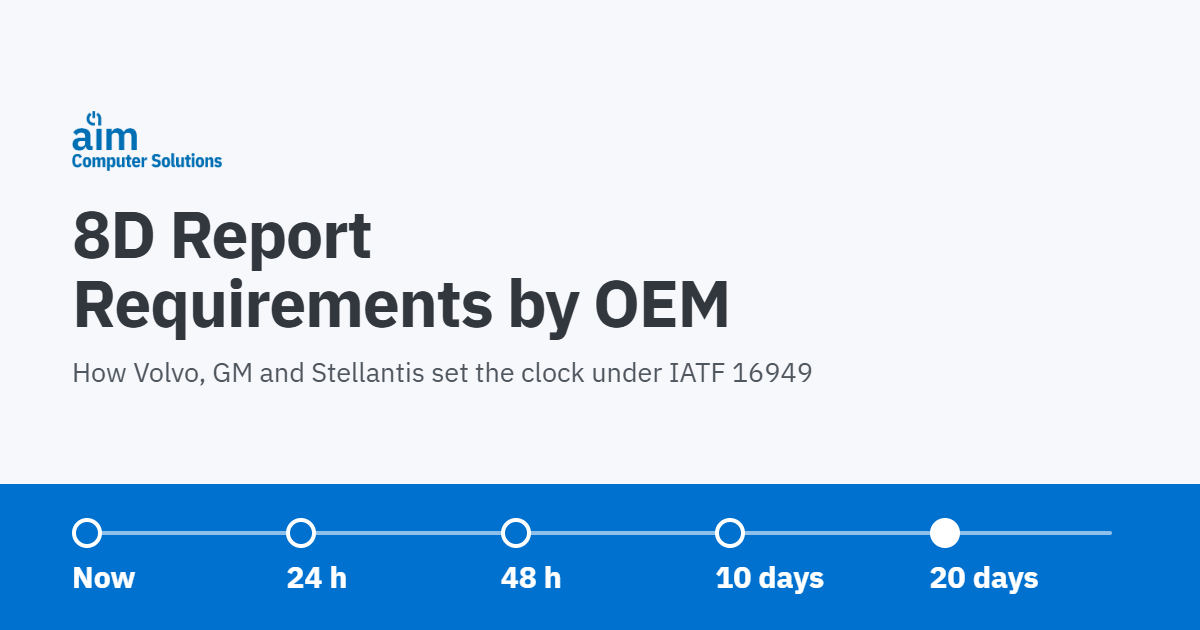
It depends on the customer's IATF 16949 customer-specific requirements. Volvo Group's CSR (v2, Feb 2025) requires containment under way within 24 hours, containment complete within 48 hours, root cause and permanent corrective action within 10 working days, and an effectiveness check within 20 working days. GM sets a daily review rather than a clock. Stellantis points suppliers to its claim procedure.
Volvo publishes the most detailed 8D clock of the OEMs reviewed here, and it makes 8D mandatory for any quality issue.
The Volvo Group 8D clock
Volvo Group IATF 16949 CSR, clause 10.2.3, v2 (28 Feb 2025)
- ImmediatelyAcknowledge the issue and start containment.
- 24 hoursContainment under way.
- 48 hoursContainment complete and short-term corrective action implemented.
- 10 working daysRoot cause (occurrence and non-detection) and permanent corrective action.
- 20 working daysEffectiveness of the corrective action checked.
The 10-working-day clock counts from confirmation and acceptance of the nonconformance, not from the first notice.
The other OEMs regulate different things. Some set a clock, some set a meeting cadence, some set the system you must use, and some set a notification rule.
| OEM | What it sets | Key requirements (paraphrased) |
|---|---|---|
| Volvo GroupCSR 10.2.3, v2, Feb 2025 | Clock | 8D is mandatory for any quality issue. Containment under way in 24 hours and complete in 48 hours; root cause and permanent corrective action in 10 working days; effectiveness checked in 20 working days. |
| GMCSR 10.2.3, effective 30 Oct 2025 | Review cadence | Issues are tracked through closure and reviewed daily by a multidisciplinary team that includes plant management, with each review documented and all organizational levels involved. Requires a robust method for verifiable root causes, timely closure with exit criteria, and documented initial containment, such as a containment worksheet. |
| StellantisCSR v1, Jun 2025 | Procedure & system | Follow the Global Supplier Claim Procedure (GSQN.001) and its timelines. In mass production, 8Ds are submitted in Stellantis tracking systems, which vary by region. Zero-kilometer and field failures are used for deep root cause analysis. Stellantis names weak root causes and PFMEAs that are not updated as recurring supplier weaknesses. |
| FordCSR, effective 15 Jun 2026 | Notification | No customer-specific requirement on 10.2.3. Under clause 8.7.1.6, if nonconforming product has shipped, notify Ford plant incoming quality, MP&L and the site STA within 24 hours or sooner. |
| IVECO GroupCSR Rev 01, Nov 2025 | Procedure & notification | Problem solving follows IVECO procedure QPS 08018, with a monthly board-level review of customer performance and action plans. Inform your certification body within 5 working days of a New Business Hold or Controlled Shipping Level 2 or 3. |
Requirements are paraphrased from each OEM's IATF 16949 customer-specific requirements. OEMs revise their CSRs; always confirm the current version on the IATF customer-specific requirements page.
Why "24 hours for containment, 30 days to close" is not a rule
Many 8D guides quote a single "typical" timeline. The CSRs above show why that breaks down for a multi-OEM supplier. The clocks differ in four ways:
Start pointVolvo's 10-working-day clock starts when the nonconformance is confirmed and accepted, not when the complaint arrives.
UnitsHours for containment, working days for root cause. A weekend inside a 10-working-day window is not lost time; inside a 24-hour window it is.
Kind of ruleGM regulates a daily review, Stellantis the system and procedure, Ford a notification. None of these is a simple deadline.
Who else must knowIVECO requires a notice to your certification body for certain escalations, which brings your IATF certificate into the conversation.
The practical answer is to track each customer's clock separately, starting from that customer's trigger, and to keep the OEM's CSR version on file with each 8D.
When the 8D is about a shipment: ASN, label and EDI rejections
Not every corrective action request starts with a bad part. A rejected advance ship notice (ASN), a container label that doesn't match the customer's format, or a shipment sent against the wrong release can all trigger a corrective action request. Good parts with bad data can still stop a receiving dock.
Clause 10.2.3 applies the same logic here. The systemic corrective action has to consider similar processes and products. If one customer rejected a label because a format rule changed, the fix should be checked against every customer, part and plant that uses the same label logic, not only the one that complained. The same goes for an ASN error caused by how shipments are built or transmitted. And if the nonconforming shipment already left, Ford's 24-hour notification rule may apply on top of the 8D.
Containment for delivery problems happens in two places: material already at the customer and material still at your dock. The second is the one you control directly. Holding a suspect container before the truck leaves is far easier than sorting it at the customer's plant.
Where AIM fits
AIM Mobility Dock Audit supports GP12 containment audits and prototype build checks at the shipping dock. It prevents shipping paperwork from printing and the ASN from transmitting until the required dock audit is complete, and keeps an audit trail of containment validations.
Behind the dock, AIM's automotive EDI software supports customer-specific EDI, AIAG barcode labeling and ASN requirements, so a format change can be applied consistently across trading partners. AIM supports these workflows; your 8D process, root cause analysis and corrective actions remain your own.
8D questions suppliers ask
What is the difference between 8D and FMEA?
An 8D responds to a problem that has already happened. A PFMEA anticipates risks before they occur. The two connect: IATF 16949 clause 10.2.3 asks suppliers to update documents such as the PFMEA and control plan after corrective action, and Stellantis names PFMEAs that are not updated as a recurring supplier weakness.
What is the difference between 8D and DMAIC?
DMAIC (define, measure, analyze, improve, control) is a Six Sigma method for planned improvement projects. 8D is a team-based response to a specific problem, usually one a customer reported, with containment built in as an early step. In automotive, the customer's CSR decides which method a complaint response must use.
Do all OEMs require an 8D?
No single rule applies. Volvo Group's CSR (v2, Feb 2025) makes 8D mandatory for any quality issue. Stellantis' CSR (v1, Jun 2025) requires 8Ds in its tracking systems in mass production. GM's CSR (Oct 2025) sets problem-solving elements without naming 8D, and Ford's CSR (Jun 2026) adds no requirement to clause 10.2.3.
Is a generic 8D report template enough?
A template helps structure the work, but it may not be what the customer accepts. Under clause 10.2.3, a customer-prescribed tool or system takes priority. Stellantis, for example, requires 8Ds to be submitted in its own tracking systems in mass production.
Keep every OEM's 8D clock on one page
Download our one-page OEM 8D clock reference for Volvo, GM, Stellantis, Ford and IVECO, with the clause and CSR version for each. Or talk with an AIM specialist about containment at the dock and scan-verified shipping.
Sources: IATF 16949:2016 with IATF Sanctioned Interpretations through Nov 2024, paraphrased. Volvo Group IATF CSR v2 (28 Feb 2025); GM IATF CSR (posted 15 Oct 2025, effective 30 Oct 2025); Stellantis CSR for use with IATF 16949 v1 (Jun 2025); Ford IATF CSR (effective 15 Jun 2026); IVECO Group CSR Rev 01 (24 Nov 2025). Published CSRs are available on the IATF website.
This article summarizes requirements for general information. It is not a substitute for your customers' current CSRs or your certification body's guidance.