Supply Chain Risk Assessment: A Guide for Automotive Suppliers
A shipment rarely falls apart all at once.
It’s usually smaller than that at first. A missed EDI exception. A label format that changed but didn’t get updated. A CUM mismatch that sat quietly in the system until somebody noticed the schedule looked…off. Then, suddenly, the dock is scrambling, the customer is unhappy, and someone is trying to explain why an ASN didn’t match what actually left the building.
That’s supply chain risk in the real world. Not always dramatic. Often boring, buried, and easy to miss.
For automotive production part suppliers, a supply chain risk assessment is not just a corporate exercise or another spreadsheet to tuck away before an audit. Done well, it’s a practical way to spot where your operation is vulnerable before those vulnerabilities become late shipments, chargebacks, customer scorecard problems, or compliance findings.
And in automotive, the risks have teeth.
Customer releases change constantly. OEM and Tier requirements are specific down to the label, dock code, ship-to location, container, ASN format, and cumulative quantity. MMOG/LE and IATF 16949 expectations add another layer of discipline. One weak handoff between EDI, inventory, production, labeling, shipping, and ASN processing can create a mess that travels fast.
That’s why risk assessment in supply chain management has to be more than a once-a-year review. It needs to live inside the way your team plans, ships, labels, validates, and reports every day.
What Is a Supply Chain Risk Assessment?
A supply chain risk assessment is a structured way to identify, evaluate, and reduce the risks that could interrupt your ability to serve customers.
That’s the clean definition.
The shop-floor version? It’s asking, “Where could this go sideways, and how would we know before it does?”
For automotive suppliers, that means looking closely at the full order-to-ship process:
Customer EDI comes in. Demand gets interpreted. CUMs are calculated. Inventory gets checked. Production gets scheduled. Materials are purchased. Finished goods are labeled, staged, verified, shipped, and reported back to the customer through an ASN.
A lot can happen in that chain.
A proper assessment helps answer questions like:
- Where are we relying on manual workarounds?
- Where do we have weak visibility?
- Which customer requirements are most likely to trip us up?
- Can we prove what happened if an auditor or customer asks?
- Are we catching problems before shipment—or after?
That last one matters. A lot.
Because once a bad shipment leaves the dock, the cost of fixing the problem usually goes up. Fast.
Why Automotive Suppliers Need a Different Kind of Risk Assessment
A general manufacturer may worry about late suppliers, bad forecasts, inventory shortages, and freight delays. Automotive suppliers worry about those things too, of course, but they also have a special brand of chaos layered on top.
EDI releases. Shipping schedules. Kanban. RANs. CUMs. AIAG labels. Customer-specific ASN rules. Standard pack rounding. Returnable containers. Line-side labeling. Toyota TSCS. Honda requirements. Ford, GM, Stellantis, Toyota, Honda, and a long tail of Tier 1 and Tier 2 requirements that don’t always behave the same way.
This is why generic risk templates can fall flat. They may ask whether you have supplier backups or freight contingency plans, which is useful, but they often miss the risks hiding in automotive execution: release accounting, label logic, ASN validation, shipment verification, and cumulative tracking.
AIM’s automotive software is built around these supplier realities, including EDI, barcode labeling, release accounting, shipping control, and compliance workflows for automotive production part suppliers.
The Risk Areas Automotive Suppliers Should Assess First
You don’t have to boil the ocean.
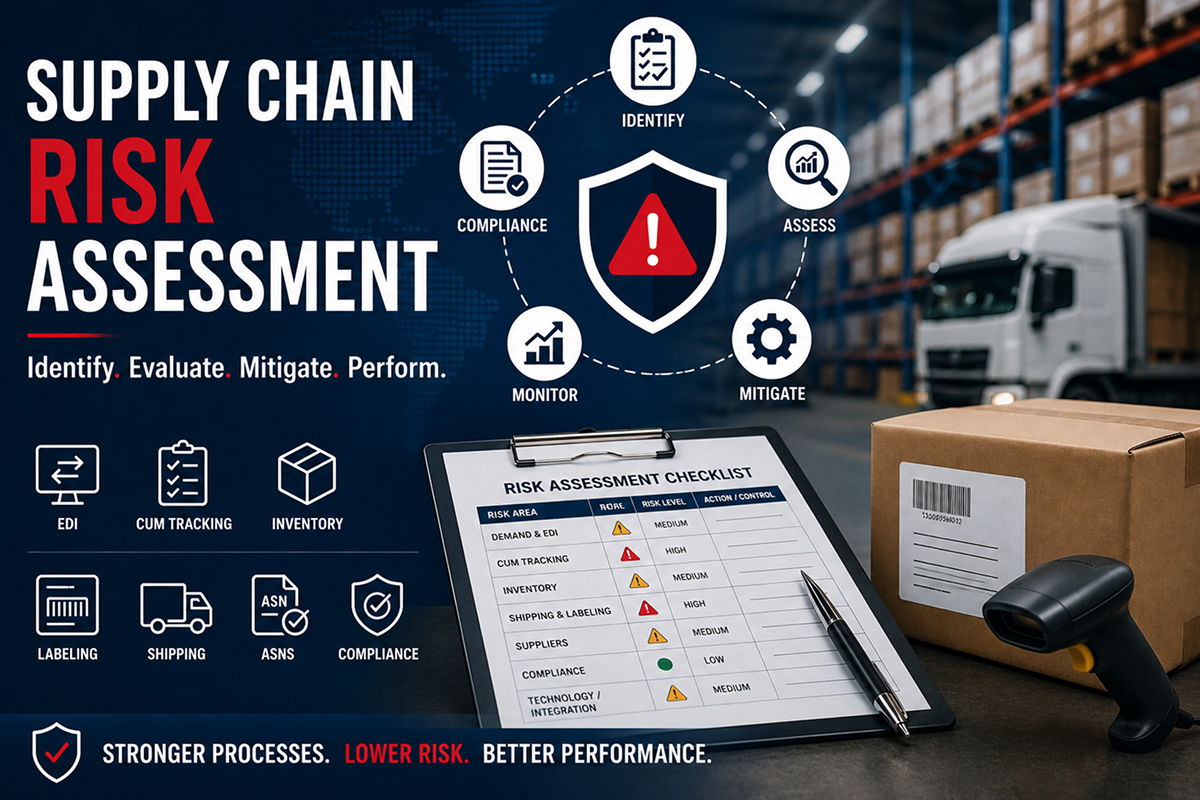
Start where the pain usually shows up: demand, inventory, suppliers, shipping, labeling, ASNs, and compliance.
Demand and EDI Risk
EDI is supposed to make things easier. And it does—when the data is interpreted correctly.
But raw EDI isn’t always simple. A customer release may include firm and planning quantities, ship dates, delivery dates, dock codes, line feed locations, cumulative quantities, and customer-specific details that need to travel cleanly through the rest of the process.
If that data gets mishandled, the downstream effects can be ugly.
A shipping schedule may not post correctly. A requirement may be missed. A planner may work from an outdated forecast. A customer may change a release, but the production schedule doesn’t reflect it quickly enough.
The risk assessment question here is simple: can your team trust that customer demand is being processed accurately, consistently, and without heroics?
If the answer is “mostly, except when Bob has to check that one report every morning,” there’s risk there. Maybe manageable risk. But risk.
AIM AutoSys supports multiple automotive EDI standards, including X.12, UN/EDIFACT, Odette, and VDA, while applying customer-specific business logic and validation to help suppliers manage inbound and outbound EDI more consistently.
CUM Tracking and Release Accounting Risk
CUMs are one of those automotive concepts that sound harmless until they’re wrong.
Cumulative accounting tracks what the customer says is required, what the supplier has shipped, and what the customer has received. When those numbers drift apart, problems follow: over-shipments, short shipments, disputes, past-due quantities, and sometimes a great deal of finger-pointing.
Here’s a supply chain risk assessment example:
A customer’s CUM received does not match the supplier’s CUM shipped. The difference is small at first, so nobody panics. Then another release arrives. The system calculates net requirements from the wrong baseline. Production builds to the wrong quantity. Shipping tries to catch up. Now the supplier may be expediting, adjusting, apologizing, or all three.
Not ideal.
A risk assessment should review how CUMs are calculated, adjusted, reset, and reconciled. It should also ask whether CUM discrepancies are visible early enough for materials, shipping, and customer service teams to act before the issue becomes a delivery problem.
Inventory Accuracy Risk
Inventory risk is sneaky because inaccurate inventory can look fine in the system right up until someone needs the parts.
Finished goods show available, but they’re not where the system says they are. WIP exists, but the location is unclear. Raw material was consumed, but not posted correctly. A cycle count reveals a variance that should’ve been caught weeks ago.
Then the schedule wobbles.
Inventory accuracy is not just an accounting concern. For automotive suppliers, it directly affects production stability, shipment readiness, traceability, and customer confidence.
AIM’s Hidaka USA case study shows how this can play out in real life. Hidaka moved away from manual inventory processes that were prone to handwriting errors and delayed variance detection, using AIM Mobility Physical Inventory to reduce direct labor from 320 man-hours to 160 man-hours while improving accuracy and audit visibility.
That’s not just a labor savings story. It’s a risk reduction story.
Supplier and Material Availability Risk
A production schedule is only as strong as the material feeding it.
Supplier delays, partial shipments, quality holds, incorrect receipts, and poor visibility into inbound material can all create disruptions. Outside processing adds another wrinkle, especially when parts move between internal operations and external processors.
The question isn’t only, “Do we have suppliers?” Of course you do.
The better question is: do you have timely, reliable visibility into what they’re sending, what’s late, what’s short, and what might affect production or customer shipments?
When supplier communication sits in emails, phone calls, and side spreadsheets, it becomes difficult to measure. And what’s hard to measure is hard to control.
Shipping, Labeling, and ASN Risk
The dock is where many supply chain risks finally show themselves.
Wrong label. Wrong container. Wrong quantity. Wrong destination. Missing paperwork. ASN sent late. ASN rejected. Shipment staged correctly but loaded incorrectly. Someone catches it, maybe. Or maybe the customer does.
Ouch.
Automotive shipping risk deserves special attention because many customer penalties happen after the supplier has already spent money producing, packing, and shipping the product. That’s a painful time to discover the process failed.
A strong assessment should ask:
- Are labels generated from validated customer requirements?
- Are quantities scan-verified before shipment?
- Are ASNs checked before transmission?
- Are shipping documents created consistently?
- Can the team see shipment status in real time?
- Are customer-specific requirements embedded into the workflow, or does someone “just know” what to do?
That “just know” part is a red flag. Tribal knowledge works until it doesn’t.
AIM AutoSys supports automated barcode label creation, ASN accuracy checks, shipping documentation, shipment tracking, and customer-specific requirements such as Toyota Shipping Confirmation System and Honda Line-Side Labeling.
Compliance and Audit Risk
A supply chain risk assessment for compliance should look past “Can we pass the audit?” and ask, “Are our daily processes repeatable, documented, traceable, and controlled?”
MMOG/LE and IATF 16949 expectations push suppliers toward disciplined execution: accurate records, clean traceability, controlled changes, customer requirement management, contingency planning, and continuous improvement.
If audit prep means chasing evidence across multiple systems, spreadsheets, and inboxes, there’s likely too much risk hiding in the process.
Common warning signs include manual ASN checks, unclear CUM adjustments, label changes handled outside the system, inventory movements without clean transaction history, and traceability gaps between raw material, WIP, finished goods, and shipments.
AIM helps automotive suppliers connect EDI, barcode labeling, inventory, shipping, receiving, production, and traceability workflows so compliance is supported every day—not just during audit season.
A Practical Supply Chain Risk Assessment Methodology
A strong supply chain risk assessment methodology doesn’t need to be complicated. In fact, the simpler it is, the more likely your team will actually use it.
Start by mapping the real order-to-ship process—not the one in the procedure manual. Follow demand from inbound EDI through planning, CUM tracking, inventory, production, labeling, shipping, ASN transmission, and customer acknowledgment.
Then group risks into clear categories:
- Demand and EDI
- Supplier performance
- Inventory accuracy
- Production
- Shipping and labeling
- ASN and customer communication
- Compliance
- Technology and data accuracy
Next, score each risk by likelihood and impact: low, medium, or high. Ask what happens if the risk occurs. Does it delay production? Affect the customer scorecard? Trigger premium freight? Create an audit issue?
Each risk should also have an owner, a control, and a way to monitor it. Avoid controls that depend on one person remembering to check a spreadsheet. That’s not a process. That’s a weak spot.
Finally, review the assessment regularly, especially after customer complaints, ASN rejections, premium freight events, audit findings, new program launches, or major customer requirement changes.
Supply Chain Risk Assessment Example for an Automotive Supplier
Here’s a simple supply chain risk assessment example for an automotive supplier shipping production parts to multiple Tier customers.
| Risk Area | Example Risk | Possible Impact | Control |
|---|---|---|---|
| EDI | 862 schedule does not post correctly | Missed or late shipment | EDI exception alerts |
| CUM Tracking | Supplier CUM differs from customer CUM | Over-shipment or short shipment | CUM reconciliation workflow |
| Inventory | Finished goods quantity is inaccurate | Shipment delay | Barcode scanning and real-time inventory |
| Labeling | Wrong AIAG label prints | Rejected shipment or relabeling | Customer-specific label logic |
| ASN | ASN missing required data | Chargeback or scorecard issue | ASN validation before transmission |
| Compliance | Lot traceability is incomplete | Audit finding or slow containment | Lot tracking and transaction history |
Most supply chain risk isn’t dramatic. It’s ordinary, repetitive, and expensive when it goes unchecked.
Supply Chain Risk Assessment Tools: What to Look For
The best supply chain risk assessment tools don’t just document risk. They help prevent it.
For automotive suppliers, look for tools that support:
Automotive EDI visibility
See what came in, what processed, what failed, and what needs attention.
CUM tracking and release history
Track customer CUM required, supplier CUM shipped, customer CUM received, release changes, adjustments, and resets.
Inventory and lot traceability
Record inventory movement as work happens, with visibility into raw material, WIP, finished goods, and shipment history.
AIAG-compliant labeling
Generate customer-specific labels without manual formatting or guesswork.
Shipping validation and ASN controls
Validate quantities, labels, containers, and shipment data before the product leaves the dock.
Reporting, alerts, and audit trails
Spot recurring issues such as EDI errors, label corrections, CUM adjustments, inventory variances, and ASN problems.
How Technology Reduces Risk Across the Automotive Supply Chain
Technology won’t fix a broken process by itself. But the right system makes a good process repeatable, visible, and harder to mess up.
For automotive suppliers, risk shrinks when teams no longer have to manually interpret EDI, rekey data, remember customer-specific rules, or visually check critical shipment details.
AIM helps connect the pieces that often drift apart: EDI, order management, inventory, production, barcode labeling, shipping, ASNs, CUM tracking, and compliance documentation.
AIM Vision provides ERP capabilities built for automotive suppliers, including EDI, barcode labeling, inventory control, production management, supply chain management, and shop-floor mobility.
AIM AutoSys adds automotive-specific EDI, labeling, shipping, ASN, and release accounting control around existing ERP systems.
AIM AutoCOR supports Epicor users with automotive EDI order management, barcode labeling, CUM tracking, and shipping workflows.
AIM AutoConnect helps suppliers keep their existing ERP while AIM manages automotive EDI complexity, including CUM logic, ship codes, transit days, standard pack rules, labeling data, and ASN processing.
Risk Assessment Should Lead to Risk Reduction
A supply chain risk assessment is only useful if it changes what happens in planning, production, shipping, and customer communication.
For automotive suppliers, the biggest risks often live in the order-to-ship process: EDI interpretation, CUM tracking, inventory accuracy, labeling, shipment validation, ASNs, and compliance records.
Get those under control, and the operation becomes more predictable. Fewer surprises. Fewer chargebacks. Stronger scorecards. Better customer trust.
Ready to reduce risk in your order-to-ship process?
Schedule a workflow review with AIM to see where EDI, labeling, CUM tracking, inventory, or ASN issues may be creating hidden supply chain risk.