Supply Chain Automation: Benefits, Logistics Use Cases, and the Future of Automated SCM
Supply chain automation is the use of integrated software, data, and digital workflows to automatically manage and optimize the flow of materials, information, and products across the supply chain—from order receipt and production planning to inventory, shipping, and delivery. Instead of relying on manual data entry, spreadsheets, and disconnected systems, automated supply chains use real-time data and rules-based logic to keep operations moving accurately, efficiently, and in compliance with customer requirements.
For today’s manufacturers and automotive suppliers, supply chain automation is no longer a “nice to have.” OEM mandates, just-in-time delivery models, labor constraints, and rising logistics costs have exposed the limitations of traditional, manual supply chain processes. Even small errors—missed ASNs, incorrect labels, inaccurate inventory counts—can lead to chargebacks, production disruptions, and damaged supplier scorecards.
Automation addresses these challenges by replacing reactive, labor-intensive processes with connected, repeatable workflows. When demand signals, inventory movements, and shipping activities are automated and synchronized, organizations gain real-time visibility, improve execution accuracy, and build a supply chain that can scale, adapt, and perform under pressure.
What Is Supply Chain Automation?
Supply chain automation refers to the use of connected systems, rules-based workflows, and real-time data to manage supply chain activities with minimal manual intervention. At its core, supply automation replaces fragmented, manual processes with coordinated digital execution—ensuring that orders, inventory, production, and logistics stay aligned as conditions change.
Rather than reacting to problems after they occur, automated supply chains are designed to prevent errors, surface exceptions early, and keep materials and information flowing accurately across the organization.
A Clear Definition of Supply Chain Automation
Supply chain automation is the orchestration of supply chain processes—such as order management, inventory control, production scheduling, shipping, and supplier communication—through integrated software platforms. These platforms apply predefined business logic, customer requirements, and compliance rules automatically, without the need for constant human intervention.
In practical terms, automation means:
-
Customer demand is received electronically and processed instantly
-
Inventory is updated in real time as material moves
-
Shipping and labeling are validated before a truck leaves the dock
-
Exceptions are flagged automatically instead of discovered after the fact
This approach allows organizations to operate faster, with greater accuracy and consistency, even as complexity increases.
What Processes Are Commonly Automated?
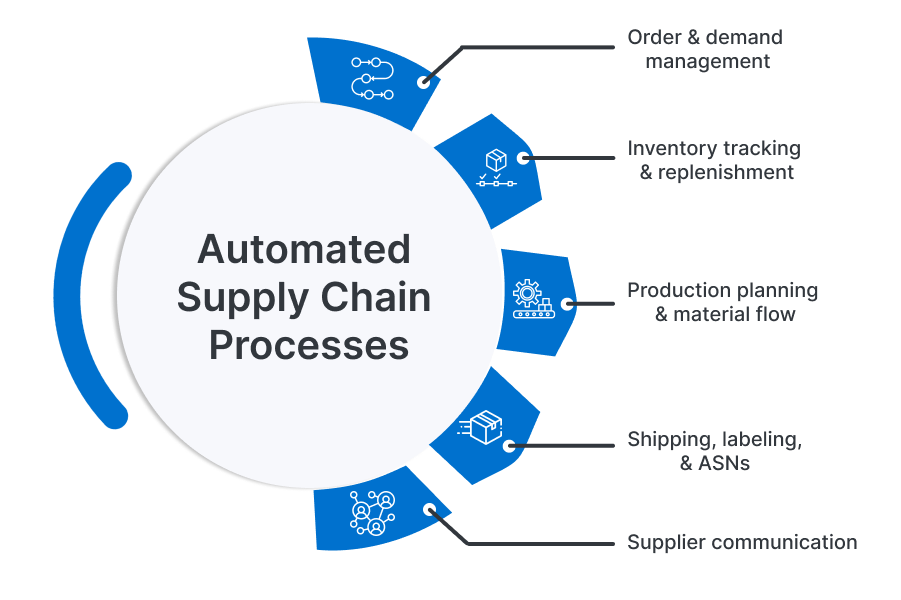 Automation in logistics and supply chain management typically spans multiple functional areas, including:
-
Order and demand management
Automating inbound customer orders, releases, and schedule changes to eliminate manual rekeying and misinterpretation. -
Inventory tracking and replenishment
Real-time visibility into raw material, WIP, and finished goods across warehouses and plants. -
Production planning and material flow
Synchronizing demand with production schedules and material availability. -
Shipping, labeling, and ASNs
Automatically generating compliant labels, validating shipments, and creating accurate advanced shipment notifications. -
Supplier communication
Automating purchase orders, supplier releases, and inbound ASNs to improve collaboration and performance.
When these processes operate together as part of an automated SCM framework, organizations reduce handoffs, eliminate data silos, and improve end-to-end execution.
Supply Chain Automation vs. Traditional Supply Chain Management
Traditional supply chain management relies heavily on manual effort, spreadsheets, and disconnected systems. Information often moves slowly, errors are discovered late, and teams spend significant time reacting to problems instead of preventing them.
Automated supply chains operate differently:
-
Manual processes are replaced with system-driven workflows
-
Data is shared in real time across departments and locations
-
Decisions are proactive, based on current demand and inventory signals
-
Compliance is built into the process, not checked after execution
The result is a more resilient, scalable supply chain—one that can handle higher volumes, tighter delivery windows, and increasing customer requirements without adding operational overhead.
In the next section, we’ll look at the core technologies that make this level of automation possible and how they work together to power modern, automated supply chain operations.
Core Technologies Powering Supply Chain Automation
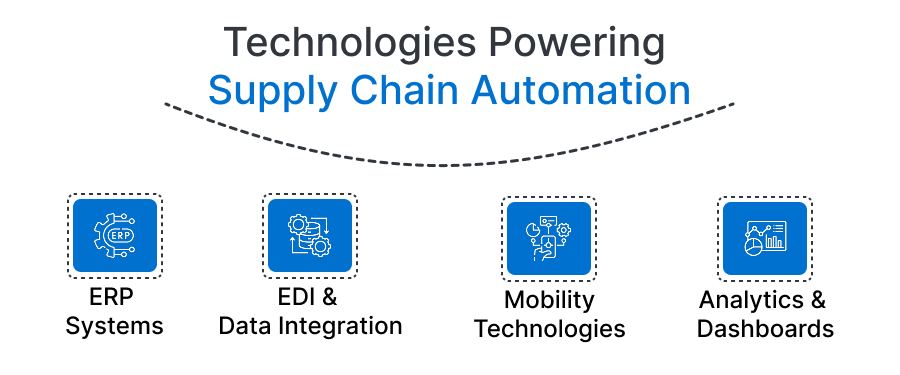 Effective supply chain automation is not driven by a single tool or platform. It is enabled by a combination of tightly integrated technologies that work together to automate execution, improve visibility, and enforce business rules across the supply chain. When these technologies are aligned, organizations move from manual coordination to a truly automated SCM environment.
ERP-Driven Automation as the Foundation
At the center of most automated supply chains is an ERP system that serves as the system of record for orders, inventory, production, and financials. ERP-driven automation ensures that data flows consistently across departments without rekeying or reconciliation.
In an automated environment, the ERP:
-
Receives and interprets demand signals
-
Updates inventory balances in real time
-
Drives production schedules and material planning
-
Feeds accurate data to shipping, labeling, and billing processes
Without ERP integration, automation efforts often become siloed and difficult to scale. A strong ERP foundation ensures that automation supports the entire business—not just individual tasks.
EDI and Data Integration
Electronic Data Interchange (EDI) is a critical enabler of automation in logistics and supply chain management, especially for manufacturers working with OEMs and Tier suppliers. EDI automates the exchange of structured business documents such as orders, releases, shipment notices, and invoices.
Key automation benefits of EDI include:
-
Automatic processing of customer schedules and order changes
-
Real-time communication with suppliers and customers
-
Elimination of manual data entry and interpretation errors
-
Faster response to demand and delivery changes
When EDI is integrated directly into order management and shipping workflows, organizations can act on demand instantly rather than reacting after delays.
Barcode, Scanning, and Mobility Technologies
Barcode labeling, scanning, and mobile devices bring automation directly to the shop floor and shipping dock. These technologies ensure that physical execution matches system expectations.
Common use cases include:
-
Scan-based receiving and inventory movements
-
Verification of picked and staged shipments
-
Real-time validation of labels and packaging
-
Enforcement of FIFO and lot traceability rules
By capturing transactions at the point of activity, barcode and mobility tools reduce errors, improve accuracy, and create a real-time feedback loop between operations and systems.
Analytics, Dashboards, and Automated Alerts
Automation is most effective when paired with visibility and intelligence. Analytics and dashboards turn operational data into actionable insight, while automated alerts highlight issues before they become costly problems.
These tools support:
-
Monitoring of on-time delivery and ASN accuracy
-
Early detection of inventory shortages or demand changes
-
Performance tracking across plants, suppliers, and customers
-
Exception-based management instead of constant manual oversight
Rather than relying on static reports or after-the-fact reviews, automated SCM environments use real-time dashboards and alerts to keep teams focused on what matters most.
How These Technologies Work Together
True supply chain automation happens when ERP systems, EDI, scanning technologies, and analytics operate as a single, coordinated ecosystem. Orders trigger production, production updates inventory, inventory drives shipping, and shipping generates compliant documentation—all automatically.
This integration is what transforms automation from isolated efficiency gains into a scalable, resilient supply chain capability.
In the next section, we’ll examine what are the benefits of automated SCM and how these technologies translate into measurable business results.
What Are the Benefits of Automated SCM?
 Understanding what are the benefits of automated SCM is critical for organizations evaluating supply chain automation beyond basic cost savings. While efficiency gains are often the initial driver, the true value of automation extends into accuracy, visibility, compliance, and long-term scalability—especially in complex manufacturing and automotive supply chains.
Improved Operational Efficiency
Automated SCM eliminates time-consuming manual tasks that slow down supply chain execution. Activities such as order entry, schedule updates, inventory adjustments, and shipment creation are handled automatically by integrated systems.
Key efficiency gains include:
-
Faster order and release processing
-
Reduced administrative workload
-
Fewer handoffs between departments
-
Shorter cycle times from demand to shipment
As a result, teams spend less time managing transactions and more time improving performance.
Greater Accuracy and Fewer Errors
Manual supply chain processes introduce risk at every step. Miskeyed orders, incorrect labels, missed ASN requirements, and inventory discrepancies are common when data is entered multiple times across disconnected systems. In contrast, automated SCM applies consistent business rules and validates transactions before execution, significantly reducing the opportunity for human error.
By automating data flow across order management, inventory, and shipping, organizations eliminate duplicate data entry and ensure that shipments and labels are validated before they leave the dock. Automated controls keep cumulative (CUM) quantities aligned between suppliers and customers, while built-in checks prevent incomplete or non-compliant ASNs from being transmitted. These safeguards ensure that what is shipped, labeled, and reported matches customer and OEM requirements every time.
The result is a measurable reduction in errors that directly impacts the bottom line. Fewer mistakes mean fewer rejected shipments, fewer chargebacks, and stronger supplier performance metrics—allowing teams to focus on execution and improvement instead of rework and correction.
Real-Time Visibility Across the Supply Chain
One of the most powerful benefits of automated SCM is real-time visibility across the entire supply chain. Instead of relying on delayed reports, spreadsheets, or manual status checks, automation gives stakeholders immediate insight into what is happening as events occur—across inventory, production, and logistics.
With automated supply chain processes, organizations gain continuous visibility into inventory levels by location and status, production progress and material availability, and shipment readiness and delivery status. Exceptions—such as shortages, delays, or mismatches between demand and execution—are surfaced early, before they escalate into missed shipments or customer disruptions.
This level of transparency allows teams to respond quickly to change and make informed decisions based on current, reliable data. Rather than reacting after problems appear, organizations can proactively adjust schedules, reallocate inventory, and communicate with customers and suppliers—keeping operations aligned and performance on track.
Cost Reduction and Profit Protection
While automation requires investment, it consistently delivers measurable cost savings over time. These savings often come from avoided costs rather than direct labor reductions.
Common cost benefits include:
-
Reduced expediting and premium freight
-
Lower inventory carrying costs
-
Fewer rework and relabeling activities
-
Minimized chargebacks and penalties
By protecting margins and improving resource utilization, automated SCM supports both short-term savings and long-term profitability.
Stronger Compliance and Audit Readiness
For regulated industries such as automotive manufacturing, compliance is non-negotiable. Automated SCM embeds compliance requirements directly into daily operations instead of relying on after-the-fact checks, manual reviews, or institutional knowledge. This ensures that compliance is enforced consistently, regardless of volume, staffing changes, or operational complexity.
By automating shipping, labeling, inventory, and documentation workflows, organizations can enforce customer-specific requirements automatically and maintain complete digital audit trails for inventory movements and shipments. Automated SCM supports industry standards such as MMOG/LE and IATF 16949 by capturing accurate, time-stamped data and reducing dependence on manual paperwork that is prone to error or omission.
This built-in approach to compliance not only simplifies internal and customer audits but also reduces operational risk. When compliance is part of the execution process—not an afterthought—organizations strengthen customer trust, improve supplier scorecards, and protect themselves from costly non-conformances.
Scalability Without Added Complexity
As businesses grow, manual processes do not scale. Automated SCM allows organizations to handle increased volume, additional customers, and more complex requirements without proportional increases in headcount or overhead.
Automation makes it possible to:
-
Support multiple plants and warehouses
-
Adapt quickly to new customer or OEM mandates
-
Standardize processes while allowing site-level flexibility
In short, automated SCM enables growth without chaos.
In the next section, we’ll look specifically at automation in logistics and supply chain management, focusing on how automation improves warehouse operations, shipping, transportation, and supplier collaboration.
Improved Customer Satisfaction and Supplier Performance
Automated SCM improves customer satisfaction by making supply chain execution more predictable, accurate, and transparent. When orders are processed correctly, shipments are validated before leaving the dock, and delivery commitments are consistently met, customers experience fewer disruptions and higher service levels.
For automotive suppliers, this reliability directly impacts OEM scorecards and long-term business relationships. Automation helps ensure on-time delivery, accurate ASNs, and compliant labeling, while also improving supplier performance through clearer communication and fewer downstream issues. The result is stronger trust across the supply chain and a reputation for consistent execution.
Faster Response to Change and Supply Chain Disruptions
Modern supply chains must adapt quickly to changing demand, material shortages, and unexpected disruptions. Automated SCM enables faster response by providing real-time data, automated alerts, and exception-driven workflows that surface issues early.
Instead of discovering problems after they impact production or shipments, organizations can adjust schedules, reallocate inventory, or communicate changes proactively. This agility allows supply chain teams to maintain performance under pressure and reduces the operational impact of disruptions. In increasingly volatile markets, the ability to respond quickly is a critical competitive advantage.
Automation in Logistics and Supply Chain Management
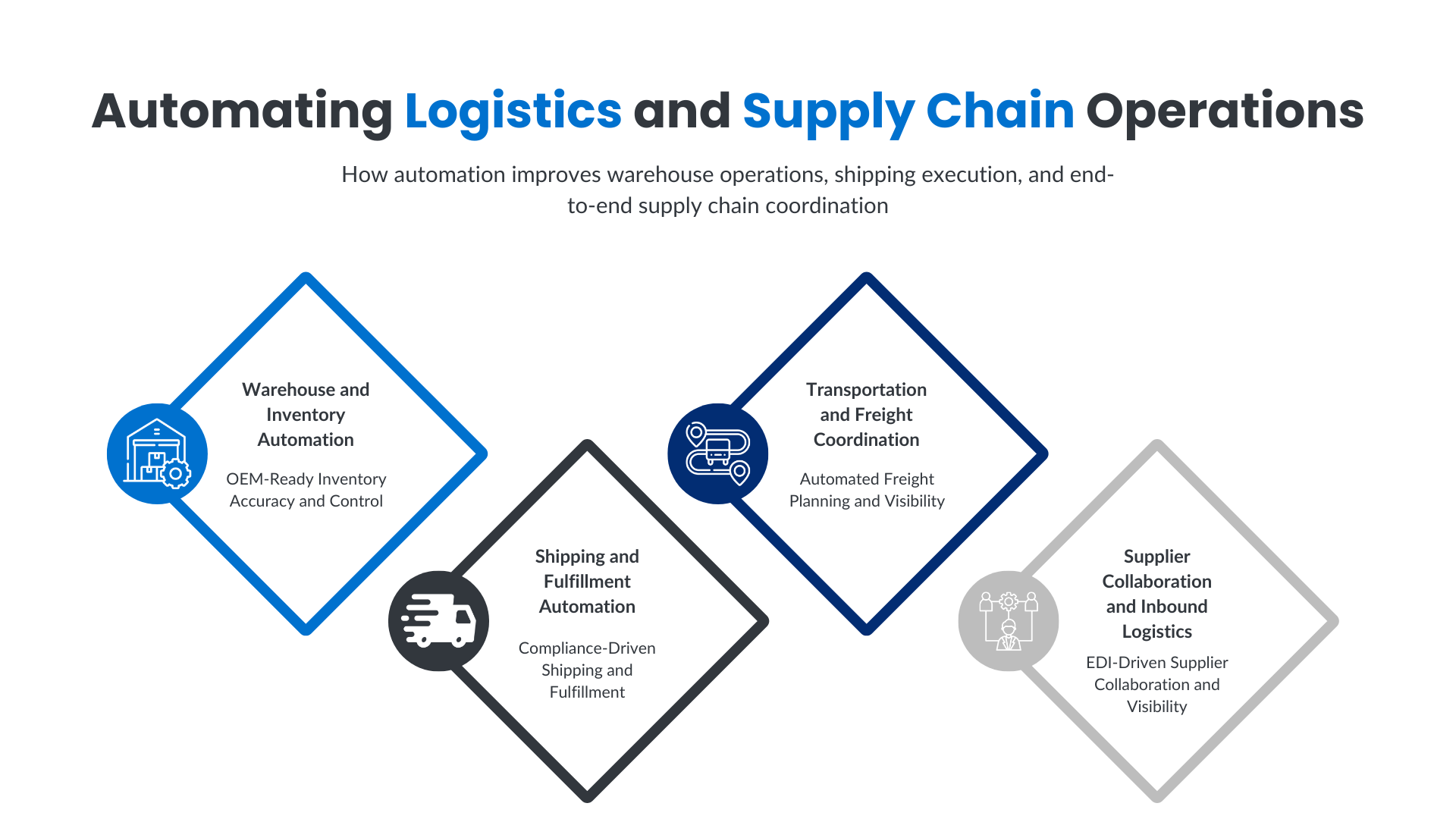 While supply chain automation often starts with planning and order management, its most visible impact is felt in automation in logistics and supply chain management—where inventory moves, shipments are built, and customer commitments are fulfilled. This is the point where automation directly affects delivery performance, customer satisfaction, and cost control.
Warehouse and Inventory Automation
Automated logistics begins inside the warehouse, where inventory accuracy and material flow directly impact production and delivery performance. Manual inventory tracking and paper-based processes often create blind spots that lead to shortages, excess stock, and shipping delays. Supply chain automation closes these gaps by providing real-time, transaction-level visibility into inventory as it moves through the operation.
Through barcode-driven receiving, picking, and staging, automated systems update inventory balances instantly by location and status. FIFO rules and lot traceability are enforced automatically, ensuring materials are used and shipped correctly without relying on manual checks. Automated replenishment triggers further stabilize operations by ensuring material is available when and where it is needed.
By capturing inventory movements as they occur, organizations reduce counting errors, improve inventory accuracy, and create more reliable production and shipping schedules. The result is a warehouse operation that supports supply chain performance instead of constraining it.
Shipping and Fulfillment Automation
Shipping is one of the most error-prone areas of the supply chain—and one of the most critical to customer satisfaction and compliance. Shipping and fulfillment automation ensures that what is packed, labeled, and shipped consistently matches customer and OEM requirements.
By automating shipper creation based on demand and inventory, validating items, containers, and pallets through scan verification, and automatically generating compliant barcode labels and ASNs, organizations reduce the risk of errors before shipments leave the dock.
These built-in controls prevent incorrect shipments, significantly reduce ASN rejections, and eliminate much of the relabeling and last-minute rework that disrupts shipping operations.
Transportation and Freight Coordination
Automation also improves how shipments are planned and executed beyond the warehouse. Instead of relying on manual decisions and spreadsheets, automated logistics systems support smarter freight management.
Automation helps organizations:
-
Select appropriate shipping methods (LTL, full truckload, pooled freight)
-
Coordinate multiple shipments across destinations
-
Track shipment status in real time
-
Respond quickly to delays or disruptions
This level of coordination reduces transportation costs while improving on-time delivery performance.
Supplier Collaboration and Inbound Logistics
Logistics automation is not limited to outbound shipments. Inbound logistics and supplier coordination are equally important for maintaining material flow and production continuity.
Automation in this area includes:
-
Automated supplier releases and schedules
-
Inbound ASN validation and receipt processing
-
Real-time visibility into incoming material
-
Supplier performance tracking
When inbound logistics are automated, organizations reduce surprises, improve supplier reliability, and maintain better control over inventory and production planning.
Why Logistics Automation Matters More Than Ever
As delivery windows tighten and customer requirements become more complex, logistics operations must execute with speed and precision. Automation in logistics and supply chain management ensures that physical execution aligns with digital plans—without relying on heroics or manual intervention.
The result is a logistics operation that is:
-
Faster and more predictable
-
Less error-prone
-
More resilient to disruption
-
Better aligned with customer expectations
In the next section, we’ll address the common challenges of supply chain automation—and how organizations can overcome them to ensure successful, sustainable automation initiatives.
Common Challenges in Supply Chain Automation (and How to Overcome Them)
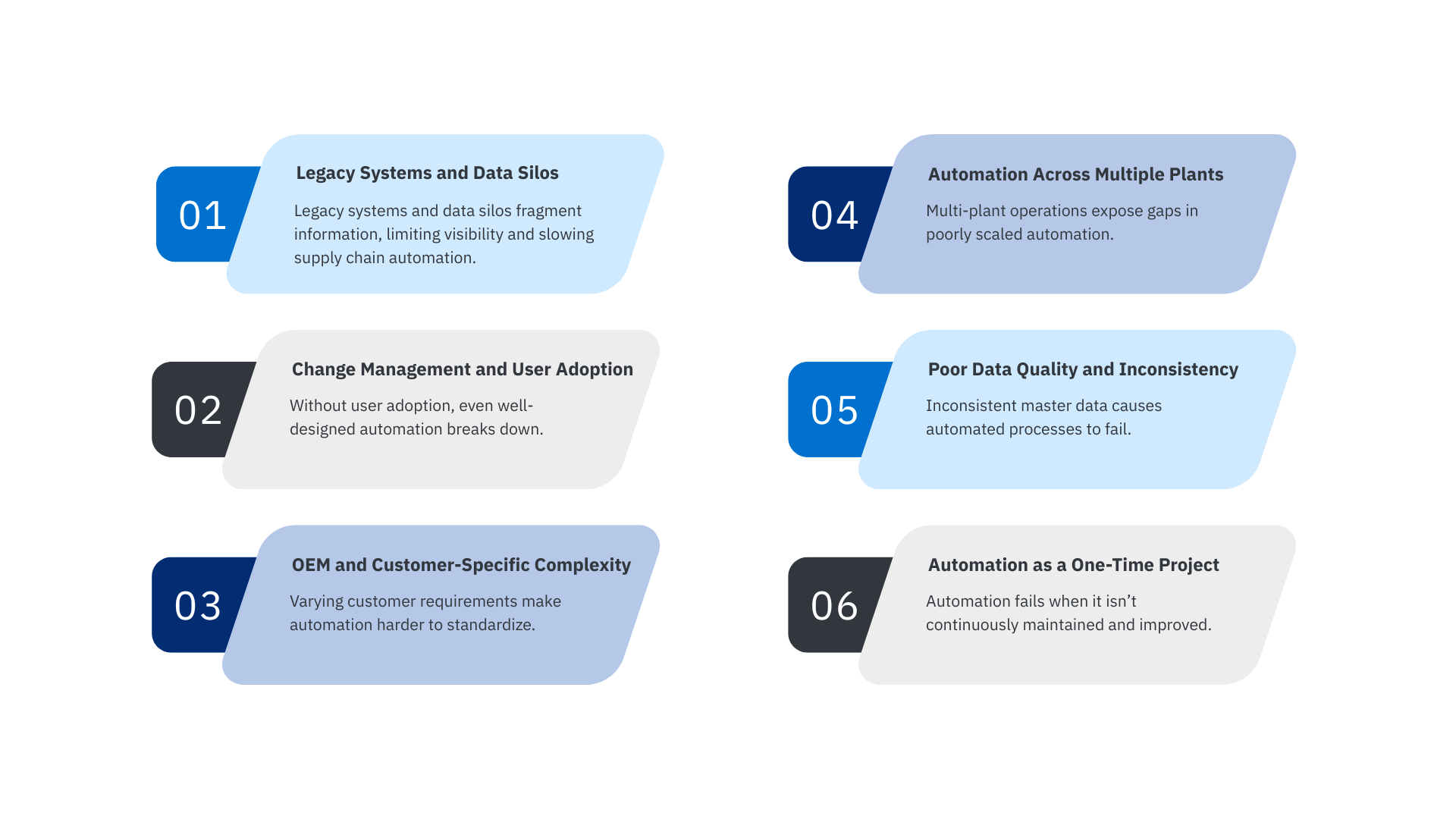 While the benefits of supply chain automation are significant, many organizations struggle to achieve full value because of practical, real-world challenges. Understanding these obstacles—and planning for them upfront—is essential to building a successful, sustainable automation strategy.
Legacy Systems and Data Silos
One of the most common barriers to automation is a patchwork of legacy systems that were never designed to work together. Disconnected ERP systems, spreadsheets, and standalone tools create data silos that limit visibility and slow execution.
Why this happens:
-
Older ERP systems lack native automation capabilities
-
Point solutions don’t share data cleanly
-
Manual workarounds become permanent
How to overcome it:
-
Use integration layers or gateways to connect systems
-
Standardize data flows across order, inventory, and shipping processes
-
Prioritize automation where data accuracy is most critical (orders, inventory, shipping)
Automation does not require replacing everything at once—but it does require reliable integration.
Change Management and User Adoption
Even the best automation tools fail if users don’t trust or adopt them. Supply chain teams are often accustomed to manual checks, spreadsheets, and “tribal knowledge,” making change difficult.
Common symptoms:
-
Manual overrides of automated processes
-
Duplicate tracking outside the system
-
Resistance from shop floor or shipping teams
How to overcome it:
-
Involve operations early in the automation design
-
Automate validation at the point of execution (scanning, verification)
-
Provide role-based training and clear visibility into system logic
Successful automation supports users—it doesn’t replace their expertise.
OEM and Customer-Specific Complexity
For manufacturers and automotive suppliers, automation is complicated by customer-specific requirements. Different OEMs use different EDI formats, labeling rules, shipping confirmations, and compliance standards.
Challenges include:
-
Frequent changes to EDI or label specifications
-
Multiple interpretations of shipping rules
-
Increased risk of non-compliance as complexity grows
How to overcome it:
-
Use solutions with embedded customer and OEM business logic
-
Centralize rules management instead of handling changes manually
-
Automate validation to prevent non-compliant shipments from leaving the dock
Automation must be flexible enough to handle variation without adding manual effort.
Scaling Automation Across Multiple Plants or Locations
What works in a single plant can break down quickly across multiple sites. Without a scalable approach, automation becomes inconsistent and difficult to manage.
Typical issues:
-
Inconsistent processes between plants
-
Limited visibility across locations
-
High administrative overhead
How to overcome it:
-
Standardize core workflows while allowing site-level control
-
Centralize data where possible, decentralize execution where needed
-
Use dashboards to monitor performance across plants
Scalable automation enables growth without sacrificing control or consistency.
Poor Data Quality and Inconsistent Master Data
Even with the right automation tools in place, supply chain automation can break down when underlying data is incomplete, outdated, or inconsistent. Inaccurate part masters, customer records, supplier data, or location definitions undermine automated workflows and create downstream errors that are difficult to diagnose.
Why this happens:
-
Master data maintained manually across multiple systems
-
Inconsistent naming conventions or units of measure
-
Changes made in one system but not synchronized elsewhere
How to overcome it:
-
Establish clear ownership and governance for master data
-
Synchronize key master data across ERP, EDI, and logistics systems
-
Use validation rules to catch data issues before they impact execution
Automation depends on trusted data. When master data is accurate and aligned, automated processes execute reliably and at scale. Without it, even well-designed automation will struggle to deliver consistent results.
Treating Automation as a One-Time Project
Supply chain automation is not a “set it and forget it” initiative. Customer requirements change, volumes fluctuate, and new challenges emerge over time.
Risks of this mindset:
-
Automation becomes outdated
-
Manual workarounds reappear
-
ROI declines over time
How to overcome it:
-
Continuously review and refine automated processes
-
Use metrics and KPIs to guide improvement
-
Treat automation as an ongoing operational capability
Organizations that view automation as a long-term strategy—not a one-time implementation—see the greatest return.
In the next section, we’ll explore how to build a supply chain automation roadmap, including how to prioritize initiatives, select the right technology stack, and measure success.
How to Build a Supply Chain Automation Roadmap
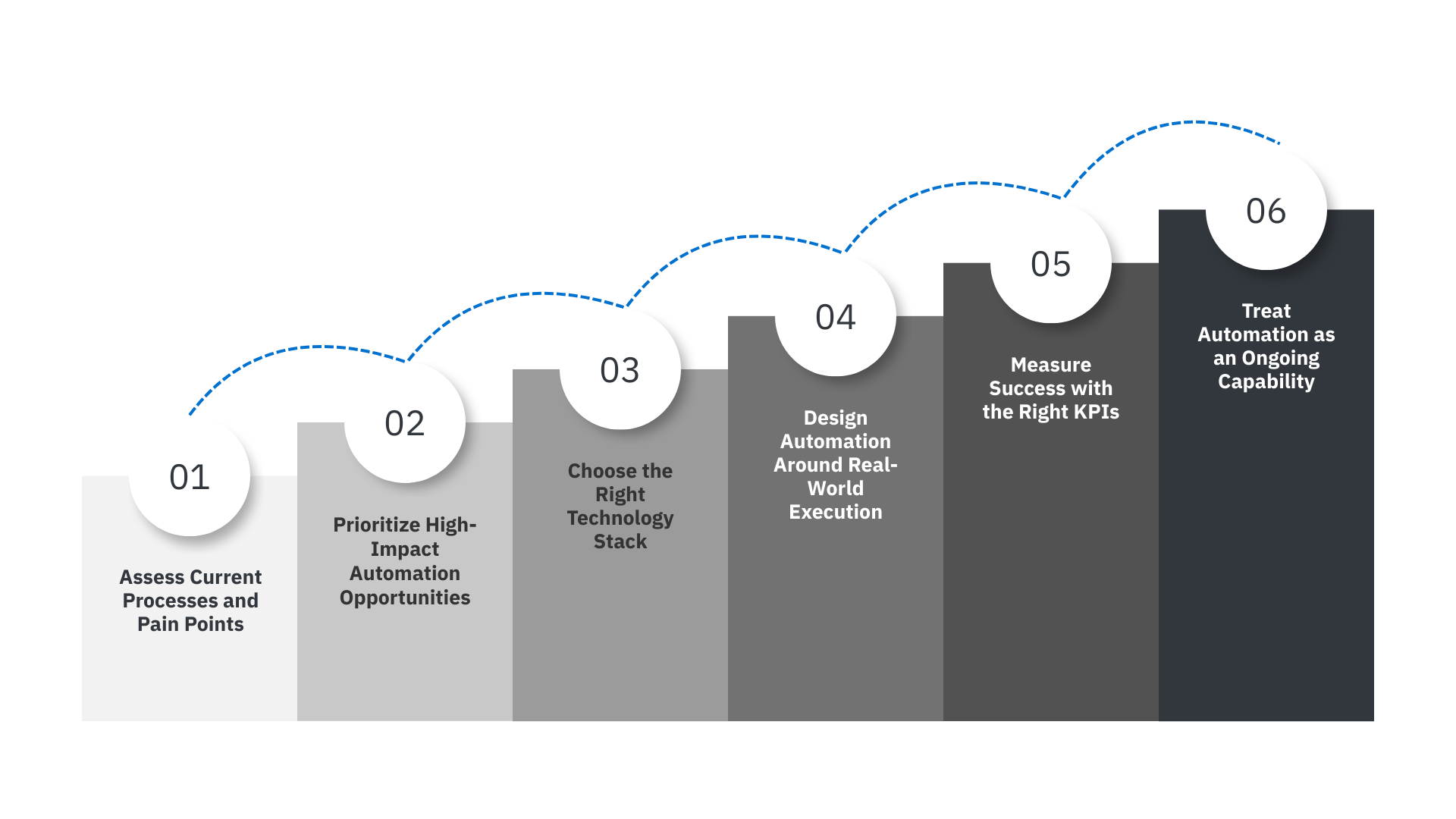 Successful supply chain automation doesn’t happen by accident. Organizations that see the greatest return approach automation as a structured, phased journey—one that aligns technology, processes, and people around clear business goals. A well-defined roadmap helps ensure that supply automation delivers measurable results instead of isolated improvements.
Assess Current Processes and Pain Points
The first step in any automation initiative is understanding where manual effort, errors, and delays exist today. This assessment should focus on how work actually gets done—not how it is supposed to work on paper.
Key questions to ask include:
-
Where are orders manually rekeyed or adjusted?
-
Which processes generate the most errors or rework?
-
Where do teams lack real-time visibility?
-
Which compliance risks rely on manual checks?
Common starting points for automation often include order management, inventory accuracy, and shipping execution—areas where even small improvements can have outsized impact.
Prioritize High-Impact Automation Opportunities
Not every supply chain process needs to be automated at the same time. The most effective automation roadmaps focus first on areas that deliver fast, tangible value while minimizing disruption to daily operations. By targeting high-impact opportunities early, organizations can build confidence in automation and demonstrate measurable results quickly.
High-impact automation often starts with order and demand processing, where manual interpretation of customer requirements introduces risk and delay. Automating inventory tracking improves accuracy and availability across warehouses and production areas, creating a more reliable foundation for planning and execution. Shipping and labeling automation further reduce errors and ASN rejections by enforcing customer requirements before shipments leave the dock, while automated exception management helps teams identify and resolve issues before execution instead of reacting afterward.
By prioritizing these critical areas, organizations build momentum, reduce operational risk, and establish a strong foundation for expanding automation across the rest of the supply chain.
Not every process needs to be automated at once. The most effective roadmaps focus first on areas that deliver fast, tangible value.
Choose the Right Technology Stack
Technology selection is a critical decision in automated SCM. The goal is not to add more systems, but to ensure the right systems work together seamlessly.
Key considerations include:
-
How well automation tools integrate with existing ERP systems
-
Whether solutions support industry-specific requirements
-
The ability to scale across plants, customers, and volumes
-
Built-in validation and compliance capabilities
Automation platforms that are purpose-built for logistics and supply chain management tend to deliver faster results and lower long-term maintenance effort than generic tools.
Design Automation Around Real-World Execution
Supply chain automation must reflect how work actually happens on the shop floor, in the warehouse, and at the shipping dock. Automation initiatives often fail when workflows are too rigid or designed in isolation from day-to-day operations. If automated processes don’t align with operational realities, teams are forced to create workarounds that undermine accuracy and reliability.
Effective automation is built around execution at the point of activity. Validation through scanning and verification ensures that materials, containers, and shipments are correct as work is performed—not after the fact. Role-based workflows support the distinct needs of operations, logistics, and quality teams, while still enforcing consistent rules across the organization. At the same time, automation must allow controlled flexibility so teams can respond to real-world conditions without sacrificing compliance.
When automation supports users instead of constraining them, adoption improves and processes become more dependable. The result is an automated supply chain that operators trust, rely on, and use as intended—driving consistent execution and long-term performance gains.
Measure Success with the Right KPIs
A supply chain automation roadmap is only as strong as the metrics used to guide it. Clear KPIs help teams track progress, justify investment, and identify areas for continuous improvement.
Common automation KPIs include:
-
ASN acceptance and rejection rates
-
On-time delivery performance
-
Inventory accuracy and turns
-
Order cycle time
-
Cost per shipment
Tracking these metrics before and after automation provides clear visibility into ROI and operational gains.
Treat Automation as an Ongoing Capability
The most successful organizations treat automation as a living capability rather than a one-time project. As customer requirements evolve, volumes fluctuate, and new challenges emerge, automated SCM must continuously adapt to the business. This requires regularly reviewing automation performance, updating rules and workflows as requirements change, and expanding automation into new areas as organizational maturity grows.
A roadmap built around continuous improvement ensures that supply chain automation remains a competitive advantage over time—not a static investment that loses relevance.
In the next section, we’ll look ahead at the future of supply chain automation and how emerging trends will shape logistics, manufacturing, and supplier collaboration in the years to come.
The Future of Supply Chain Automation
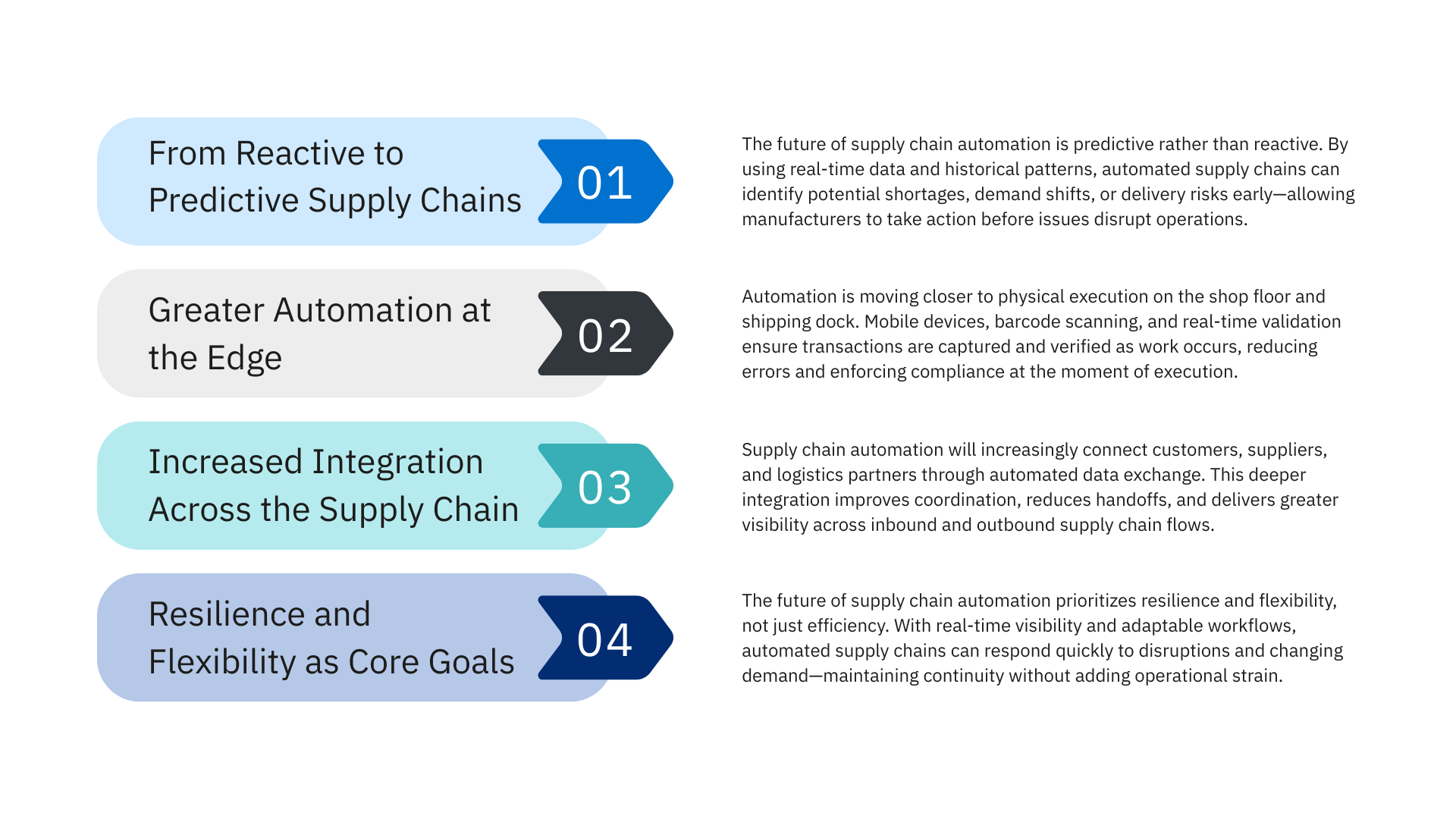 The future of supply chain automation is being shaped by rising complexity, tighter customer expectations, and the need for greater resilience across global supply networks. Automation is no longer just about efficiency—it is becoming a core capability that enables organizations to anticipate change, respond faster, and maintain control in an increasingly unpredictable environment.
From Reactive to Predictive Supply Chains
Traditional supply chains respond to problems after they occur. The future of automated SCM is predictive—using real-time data, historical trends, and rules-based logic to identify issues before they disrupt operations.
As automation matures, organizations will increasingly rely on:
-
Early signals from demand and inventory data
-
Automated alerts for potential shortages or delays
-
Forward-looking visibility into production and shipping constraints
This shift allows supply chain teams to move from firefighting to proactive decision-making.
Greater Automation at the Edge: Shop Floor and Dock
One of the most important trends in supply automation is the expansion of automation closer to physical execution. Instead of limiting automation to planning and back-office systems, organizations are increasingly bringing automation directly to the shop floor and shipping dock. Mobile devices, barcode scanning, and real-time validation tools are making it possible to connect digital processes with physical activity as it happens.
As automation at the edge continues to mature, more organizations will automatically validate shipments as they are built, capture inventory movements in real time without manual data entry, and enforce compliance at the moment of execution rather than after the fact. This shift reduces delays, prevents errors before they occur, and eliminates the need for rework caused by late discovery of issues.
This concept of “edge automation” ensures that physical execution always aligns with system expectations. When what is scanned, moved, and shipped matches what the system records in real time, organizations gain higher accuracy, stronger compliance, and greater confidence in their supply chain performance.
Increased Integration Across the Supply Chain Ecosystem
Supply chain automation will continue to expand beyond the four walls of the enterprise. Customers, suppliers, logistics providers, and other partners are becoming more tightly connected through automated data exchange, creating supply chains that operate as coordinated networks rather than isolated organizations.
As this integration deepens, organizations will see closer alignment with suppliers for inbound materials and ASNs, enabling better visibility and more predictable material flow. Automated onboarding will make it faster and easier to connect new customers and trading partners without lengthy manual setup or custom processes. At the same time, greater standardization of data formats and workflows across supply chain networks will reduce complexity and improve consistency.
This level of ecosystem-wide integration improves coordination, reduces friction between partners, and strengthens overall supply chain performance. When information flows automatically and reliably across the entire network, organizations can respond faster, collaborate more effectively, and operate with greater confidence in an increasingly connected supply chain environment.
Resilience and Flexibility as Core Automation Goals
Recent disruptions have made one thing clear: supply chains must be resilient, not just efficient. The future of supply chain automation will prioritize flexibility—enabling organizations to adapt quickly to changes in demand, supply, or logistics conditions.
Automation supports resilience by:
-
Providing real-time visibility during disruptions
-
Allowing rapid reconfiguration of workflows
-
Reducing dependence on manual interventions
Organizations with automated SCM are better positioned to absorb shocks and recover faster.
What the Future Means for Manufacturers and Automotive Suppliers
For manufacturers—especially automotive suppliers—the future of supply chain automation will bring significantly higher expectations from OEMs and customers. Accuracy, compliance, and responsiveness will no longer serve as competitive differentiators; they will be baseline requirements for doing business.
Automation will be essential for meeting evolving OEM mandates, managing higher volumes with fewer resources, and maintaining compliance with industry standards such as MMOG/LE and IATF 16949. As supply chains become more complex and fast-moving, success will increasingly depend on reliability and execution consistency—not just cost. Organizations that invest in automation today will be far better positioned to meet tomorrow’s demands without adding unnecessary complexity or operational risk.
Conclusion: Turning Supply Chain Automation into a Competitive Advantage
Supply chain automation is no longer just about replacing manual tasks—it is about building a supply chain that is accurate, resilient, and ready to scale. By automating order management, inventory control, logistics execution, and supplier collaboration, organizations gain the visibility and control needed to operate efficiently in an increasingly complex environment.
As we’ve explored, the benefits of automated SCM extend well beyond efficiency. Automation improves accuracy, reduces costly errors, strengthens compliance, and enables faster, more confident decision-making. When supply automation is implemented with the right technology and a clear roadmap, it becomes a strategic asset that protects margins, supports growth, and improves customer performance.
Looking ahead, the future of supply chain automation will favor organizations that can adapt quickly, enforce compliance at the point of execution, and maintain real-time alignment between digital plans and physical operations. For manufacturers and automotive suppliers in particular, automation is becoming a baseline requirement to meet OEM expectations and remain competitive.
The question is no longer if supply chain automation is necessary—but how effectively it is implemented.
Ready to take the next step?
Now is the time to evaluate where manual processes, visibility gaps, or compliance risks are holding your supply chain back. Whether you’re looking to automate EDI, streamline logistics, improve inventory accuracy, or prepare for future growth, the right automation strategy can deliver measurable results.
Explore how modern supply chain automation can transform your operations—schedule a conversation, request a demo, or review a real-world customer success story to see what’s possible.