EDI 866 vs 862: Production Sequence vs. Shipping Schedule
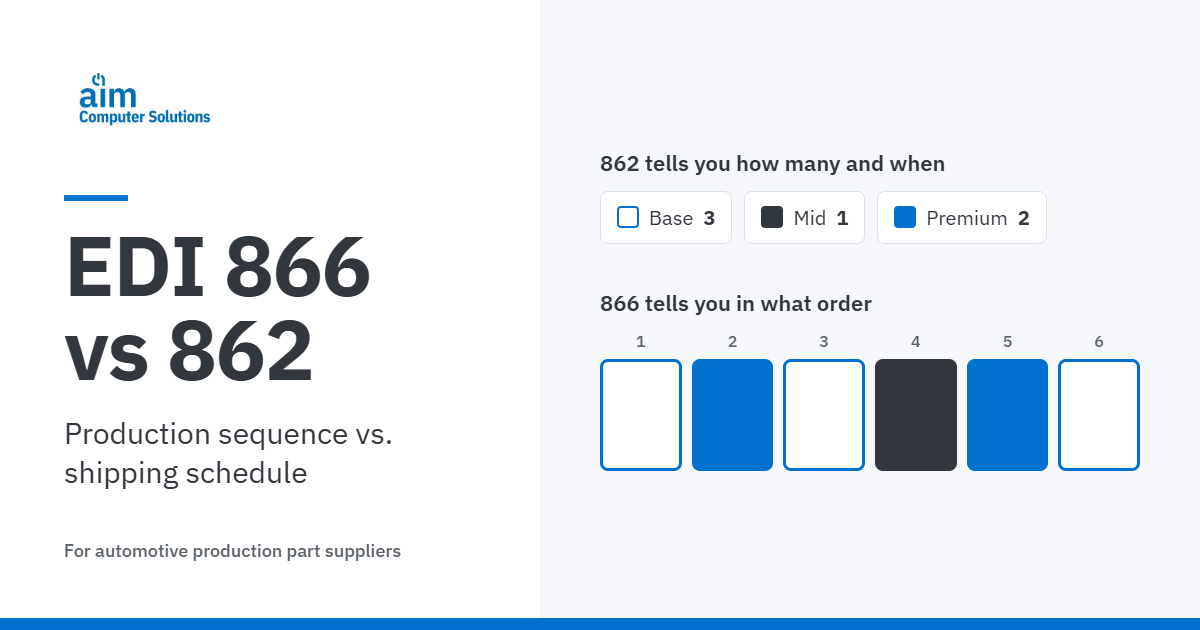
Your 862 asks for three base consoles, one mid-trim and two premium for the 8:00 window. You ship exactly that, on time. The plant still calls, because the line needed those six consoles in vehicle order, and your trailer was loaded in part-number order. The quantities were right. The sequence was wrong.
That gap is the difference between the EDI 862 Shipping Schedule and the EDI 866 Production Sequence. If you've just been awarded a sequenced program, or a customer has asked whether you can "receive 866s," this article explains what the 866 does, how it works alongside the 862, and what it demands from your shipping floor.
The short answer
The EDI 862 tells you how many and when: firm quantities by part, date and sometimes time of day. The EDI 866 tells you in what order: the sequence in which parts must arrive or be consumed on the customer's line, often tied to individual vehicles.
The 866 doesn't replace your release. Under the X12 standard, it isn't used to authorize material or labor. It sequences demand that your planning and shipping schedules already cover. How each customer uses it varies by program, so the customer's implementation guide always governs.
EDI 862 vs 866 at a glance
Both documents come from your customer, and both can cover the same parts on the same day. They answer different questions.
| Attribute | EDI 862 | EDI 866 |
|---|---|---|
| X12 name | Shipping Schedule | Production Sequence |
| Question it answers | How many, and when? | In what order? |
| Driven by | Part, date and time buckets | The customer's build or consumption sequence |
| Typical granularity | A quantity per part per date or window | One part or set per sequence position, often per vehicle |
| Authorizes material? | Carries firm shipping requirements | No. The X12 standard says it isn't used to authorize labor, materials or other resources |
| Key identifiers | Part number, CUM quantities, ship or delivery dates | Sequence numbers, a vehicle reference such as a VIN, part number, delivery window |
| What it drives for you | Shipping, dock scheduling, ASN quantities | Build, pick and staging order, sequence labels, load order |
| Where errors show up | Short or over shipments, CUM gaps, ASN disputes | Wrong part at a station, a part on the wrong vehicle, line disruption |
| EDIFACT counterpart | DELJIT | DELJIT, in some implementations |
Horizon, frequency and content vary by customer and program. Each trading partner defines them in its own EDI implementation guide.
What is an EDI 866?
The 866 Production Sequence is an ANSI X12 transaction set that lets the receiver of goods specify the order in which shipments arrive, the order in which goods are unloaded, or both, so that parts enter material handling or production in a defined sequence. In automotive, that sequence is usually the order vehicles will move down the customer's assembly line. You'll also hear it called a line sequence, a sequenced call-off, or in-line vehicle sequencing (ILVS).
Why sequenced supply exists
Mixed-model assembly lines build different trims, options and configurations back to back. For large or high-variant parts such as seats, consoles, cockpit modules or bumpers, the plant can't hold every variant at the station. Instead, it asks the supplier to deliver parts already sorted into build order, so each part arrives at the station just before the vehicle it belongs to. That's just-in-sequence (JIS) supply: just-in-time controls quantity and timing, and just-in-sequence adds order.
The trade-off is that there's little or no line-side buffer. A part in the wrong position doesn't sit in a rack until someone notices. It shows up at the station, on the wrong vehicle, right away.
What an 866 typically carries
At a conceptual level, most 866s include:
- A header with the schedule number, issue date, horizon and whether this is an original or a replacement sequence.
- The parties: the plant or line receiving the parts and the supplier shipping them.
- Delivery windows, each opening a block of sequenced parts.
- Sequenced line items: a load or job sequence number, the buyer's part number and, in many programs, a vehicle reference such as a VIN or chassis number.
- Totals that let you check the file is complete.
Here's a simplified, illustrative excerpt. It isn't any customer's specification.
BSS*00*SEQ-1104-0800*20261103*JS*20261104*20261104*R110401~Beginning segment. Original sequence (00), schedule number, issue date, production-sequence schedule type (JS), horizon dates and a release number.N1*ST*ASSEMBLY PLANT 1*92*PLT1~The plant receiving the parts. Suppliers serving several plants or lines route each 866 by this code.DTM*002*20261104*0800~Delivery requested: Wednesday at 08:00. Every line item below belongs to this window until the next DTM.LIN**LS*0001*JS*J0458821*BP*7101-BASE~Load sequence position 1, the plant's job sequence number and the buyer's part number.QTY*01*1*EA~One piece for that position.LIN**LS*0002*JS*J0458822*BP*7101-PRM~Position 2 is a different variant. This is where the sequence starts to matter.CTT*1*6~Totals: one delivery window, six pieces. What each total counts is set by the customer's guide.Which qualifiers a customer sends, where the vehicle reference lives, and in what order, all vary. Map by qualifier, not by position, and test against the plant's real files. If you're new to how X12 transaction sets are built, our overview of EDI standards is a good starting point.
Why some definitions sound different
If you search for the 866, you'll find two descriptions that don't seem to match. Some describe it as a request for the order in which shipments arrive at a dock or are unloaded from a truck. Others describe it as the vehicle build sequence. Both come from the same standard. The X12 definition is written broadly enough to cover dock arrival and unloading order. In automotive, OEMs use it for the narrower, higher-stakes case: the order parts must reach the line to match the vehicles being built.
Where the 866 fits among your release documents
Think of your customer's schedules as layers, each closer to the moment of production than the one before. Your 856 then confirms what actually left your dock.
Not every program sends all three schedules. Some customers send an 830 and an 866 with no 862. Others carry sequence detail in a different document or standard. For customers that issue purchase orders instead of releases, see how the EDI 850 works in automotive. For how the 830 and 862 divide planning and shipping, and how CUMs connect them, read EDI 830 vs 862.
Worked example: right parts, wrong order
Here's the scenario from the top of this article, laid out position by position. One part family, three variants, one delivery window. All part numbers and quantities are illustrative.
Console family 7101, Wednesday 08:00 window
The 862 and the 866 describe the same six consoles. Only one of them tells you the order.
The 862 says quantities by part, for the window
The 866 says the order the line will consume them
- Seq 1Base
- Seq 2Premium
- Seq 3Base
- Seq 4Mid
- Seq 5Premium
- Seq 6Base
Loaded to the 862 only picked and loaded in part-number order
- Seq 1BaseMatches
- Seq 2Base✕ Needs Premium
- Seq 3BaseMatches
- Seq 4MidMatches
- Seq 5PremiumMatches
- Seq 6Premium✕ Needs Base
What doesn't change: your CUMs
Notice that both loads ship the same quantity of each part. In this example, the 866 changes the order, not the demand. Your CUM shipped still reconciles against the customer's CUM received and the quantities on the 830 and 862, exactly as it would without sequencing. That's the practical meaning of the standard's rule that the 866 doesn't authorize material: release accounting stays with your planning and shipping schedules, and the 866 adds a second requirement, order, on top of it.
Some customers define the relationship differently. In programs with no 862, for example, the 866 may be the nearest-term signal you have for what to ship. Confirm how each customer intends the documents to work together before you build your process around one model.
When the 862 and the 866 don't agree
The worked example is the clean case. In practice, the two documents won't always line up. These are the situations to plan for, and the questions to settle with your customer before they happen.
- The counts differ. The 866 for a window adds up to more or fewer pieces of a part than the 862 shows. Know which document your customer expects you to follow for that window, and how it wants the difference reflected in your ASN and CUMs.
- A replacement sequence arrives. Many customers resend the sequence when the build order changes. A replacement supersedes the earlier sequence for its horizon. If your process doesn't recognize that, you'll build or stage to an order the plant has already abandoned.
- A vehicle is held or pulled from the line. Its sequence position may be skipped, moved or reissued later. Ask how the customer communicates holds and what it expects you to do with parts already built for that position.
- Sequence numbers are missing or duplicated. A gap means a vehicle with no part. A duplicate means a vehicle with two. Check every window before you stage it, not after the truck leaves.
- The file is late. Sequenced windows leave little slack. Know what you're expected to do if an 866 doesn't arrive when it should, and who to call.
What sequencing demands from your operation
Receiving an 866 is the easy part. Executing to it touches almost every step between your EDI inbox and the trailer door.
Process the sequence the moment it arrives
The time between receiving a sequence and the delivery window can be short. Any step that waits for someone to open a file, rekey it or print it eats into that window. Sequenced programs work best when inbound 866s are processed automatically, checked for gaps and duplicates, and pushed straight to the floor.
Build, pick or stage to sequence
Depending on the part, you may build to sequence, pick finished goods into sequence, or stage them in sequenced racks or containers. Whichever model you use, the sequence number has to travel with the part from the moment it's assigned until it's on the truck. Sorting by part number at any step breaks the chain.
Labels that match the sequence
Sequenced parts usually carry labels that identify their position, and often the vehicle they're built for, in addition to the standard part, quantity and supplier data. The content and format are set by each customer. When labels are generated from the same data as the sequence, they stay in step. When they're built separately, they drift. AIM's AIAG barcode labeling software page covers how customer-specific label requirements are typically managed.
Load the trailer in the right order
The order parts come off the truck has to match the order the line needs them. That often means loading in reverse, so the first sequence position is the last one in and the first one out. Racks and containers need to be loaded with the same discipline as the parts inside them.
An ASN that reflects what's on the truck
Your EDI 856 confirms what you shipped. For sequenced programs, customers may expect the ASN to reflect the shipment by window or by load, in addition to part and quantity. Check how your customer wants sequenced shipments represented, and make sure the ASN is built from what was actually scanned onto the trailer, not from what was planned. If you're unsure what a rejected ASN is telling you, our article on EDI 997 vs. 824 explains why a clean acknowledgment doesn't mean the ASN was accepted.
When you ship through a third-party sequencer
Not every sequenced program has you delivering straight to the line. Some customers use a third-party sequencing center near the plant. In that model, you may ship to the sequencer rather than to the line, and the sequencer handles the final order. Your EDI requirements, labels and ASN expectations may then come from the sequencer as well as, or instead of, the OEM plant. Confirm who sends what, and who you're shipping to, before the program launches.
Global customers: DELJIT and VDA equivalents
Customers outside North America, and some global Tier 1s, send sequence requirements in UN/EDIFACT or VDA formats rather than X12. The concepts carry over. The message structures don't.
| Standard | Shipping schedule (862 role) | Sequenced call-off (866 role) |
|---|---|---|
| ANSI X12 | 862 Shipping Schedule | 866 Production Sequence |
| UN/EDIFACT | DELJIT | DELJIT, in some implementations, used for sequenced call-offs |
| VDA | VDA 4915, and its EDIFACT-based successor VDA 4985 | VDA 4916, and its EDIFACT-based successor VDA 4986 |
Mappings vary by customer. Some send both quantities and sequence in one message type. Always confirm against the customer's guide.
Five common 866 mistakes
- Treating the 866 as additional demand. Adding 866 quantities on top of 862 quantities for the same window double-counts demand and inflates your CUMs.
- Shipping to quantity and ignoring order. The right count in the wrong order still fails at the line, as the worked example shows.
- Missing a replacement sequence. Building to yesterday's build order is one of the fastest ways to put the wrong part on the wrong vehicle.
- Generating labels separately from the sequence. If labels and sequence data come from different places, they will eventually disagree, and the label is what the line scans.
- Tracking the sequence outside your system. Spreadsheets and printouts add delay and rekeying errors in the one process with the least room for either.
Questions to confirm with every sequenced customer
Most sequencing problems trace back to an assumption about how a customer uses its documents. Ask these during program launch, and again when a customer changes its EDI version or adds a plant or line.
- Do you send an 866, or do you carry sequence in another document or standard?For example, sequence detail in DELJIT or a VDA call-off.
- Do you also send an 862, and which governs if their quantities differ?
- Does each new 866 replace the previous one, and over what horizon?
- Which vehicle reference do you send, and where in the file?VIN, chassis number, job sequence number or another identifier.
- What must appear on sequence labels, and in what format?
- How do you communicate held, pulled or re-sequenced vehicles?
- How much time is there between receiving the sequence and the delivery window?
- Do we deliver to the line or to a third-party sequencer?
- How should sequenced shipments appear in our 856?
- Which standard and version do you use?X12 version, EDIFACT or VDA.
What your system should do with 866s
Whatever software you run, sequenced programs need these capabilities:
- Receive and process 866s automatically, without rekeying.
- Check each sequence for gaps, duplicates and late arrival, and alert someone when they occur.
- Apply replacement sequences correctly, so the floor always works to the latest build order.
- Keep sequence logic separate from release accounting, so CUMs and net requirements stay accurate.
- Generate sequence labels from the same data as the sequence and the shipment.
- Verify what's loaded by scanning, and build the ASN from what was scanned.
- Handle each customer's rules individually, rather than one global rule for every trading partner.
Generic ERP systems often handle orders and inventory well, but weren't designed around automotive release accounting or sequenced shipping. That's where rekeying and side spreadsheets creep in, and why shipping errors cluster around the documents a supplier's core system wasn't built to understand.
How AIM handles sequenced requirements
AIM AutoSys
AIM AutoSys works alongside your ERP to manage automotive EDI, order management, release accounting, labeling and shipping. For sequenced programs, it:
- Handles In-Line Vehicle Sequencing (ILVS) through the X12 866, aligning production schedules with OEM requirements.
- Tracks customer and supplier cumulative requirements and manages variances, so sequencing doesn't distort net requirements.
- Automates barcode label creation for production and shipping, tailored to each customer's specifications.
- Reduces ASN rejections with built-in error detection based on OEM business logic.
- Processes EDI automatically, including during off hours.
- With the AIM Mobility: Shipping add-on, scan-verifies shipments and flags exceptions between what was ordered and what was scanned.
AIM also maintains pre-built EDI maps for automotive trading partners, including line-sequencing maps, with more than 535 trading partner connections in all.
Explore AIM AutoSysRunning Epicor Kinetic, keeping your ERP for shipping, or replacing your ERP? Sequencing touches labeling, scanning and loading, so the right setup depends on which system owns shipping execution. Talk to an AIM specialist about your environment.
Taking on a sequenced program?
Send us one customer's 866 and 862. An AIM specialist will walk through how the two documents work together for that customer, how sequence labels and your ASN should line up, and where your current process could break sequence.
It's a workflow review, not a product pitch.
Frequently asked questions
What is an EDI 866?
The EDI 866 is the ANSI X12 Production Sequence transaction set. Customers use it to tell suppliers the order in which parts must arrive or be consumed. In automotive, that order usually matches the vehicles moving down the assembly line, which is why it's used in just-in-sequence and in-line vehicle sequencing (ILVS) programs.
What is the difference between EDI 866 and EDI 862?
The 862 Shipping Schedule gives firm quantities and dates to ship: how many and when. The 866 Production Sequence gives the order in which those parts must arrive, often vehicle by vehicle. Many sequenced programs use both, with the 862 setting quantities and the 866 setting order.
Does an EDI 866 authorize shipment or material?
Under the X12 standard, the 866 isn't used to authorize labor, materials or other resources. Authorization comes from the planning and shipping schedules and the supply agreement. Some customers apply their own rules, so confirm with each one.
What is just-in-sequence (JIS) delivery?
Just-in-sequence is a delivery model where parts arrive already sorted into the build order of the vehicles they're for. Just-in-time controls quantity and timing; just-in-sequence adds order. The 866 is how many customers communicate that order.
What is ILVS?
ILVS stands for in-line vehicle sequencing: delivering parts in the order vehicles move down the customer's line. In X12, ILVS requirements are typically communicated with the 866 Production Sequence.
Is the EDI 866 the same as EDIFACT DELJIT?
No. DELJIT is the EDIFACT just-in-time call-off message, so its closest X12 counterpart is the 862 Shipping Schedule. The 866 Production Sequence has no standalone EDIFACT equivalent, so some customers carry sequence data inside DELJIT, and exactly how is defined in each customer’s implementation guide. That is why AIM maintains customer-specific EDI maps instead of treating the standards as interchangeable.
Do I need to support the 866 if I already receive 862s?
Only if a customer requires sequenced delivery for some of your parts. If it does, the 862 alone won't tell you the order, and shipping the right quantities in the wrong order still fails at the line.
How does the 866 affect my labels and ASN?
Sequenced parts usually need labels that identify their sequence position and often the vehicle they're for, and customers may expect the 856 to reflect the shipment by window or load. Both should be built from the same sequence and scan data, so they always match what's on the truck.
EDI segment examples, part numbers and quantities in this article are simplified illustrations, not any customer's implementation guide. Always follow your trading partner's published EDI specifications and supplier requirements.